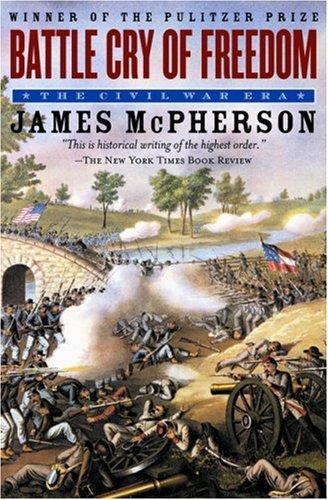
Talk to Battle Cry of Freedom: The Civil War Era like its author wrote you back.
Get the ideas that fit your life — not generic summaries.
- Chat with the book
- Audiobook-style main ideas
- Adapts to your life and goals
- Helps you take action
Battle Cry of Freedom: The Civil War Era, in detail
James McPherson's Battle Cry of Freedom, published in 1988, is the standard one-volume history of the Civil War era and won the Pulitzer Prize in the year of its publication. It covers the period from the 1840s through Appomattox, integrating political, economic, social, and military history in a way that most single-volume Civil War accounts do not attempt. McPherson is clear about what caused the war: slavery, and the specific conflict over its extension into new territories.
The book's first third covers the antebellum period — the Mexican War, the Kansas-Nebraska Act, the rise of the Republican Party, the disintegration of the Democratic Party, and the sequence of events that made secession feel like a viable option to Southern leaders by 1860. McPherson gives more weight to this pre-war political history than most narrative accounts do, and the payoff is that the war itself, when it arrives, feels like a logical outcome rather than a surprise. The book's military sections are detailed but never allow battles to crowd out political context.
McPherson argues throughout that the war's outcome was not predetermined. Contingency is his word: at multiple moments, different decisions by generals, presidents, or electorates could have produced different results. The 1864 election, in which Lincoln came close to losing to the peace candidate George McClellan, is given particular weight as a moment when the entire Union war effort nearly collapsed from within. Grant's campaigns in Virginia that summer, brutal as they were, were not just military operations but political interventions designed to keep the Northern electorate willing to continue.
The book ends at Appomattox and does not attempt to cover Reconstruction in detail. What it does accomplish is a coherent account of how a republic built on a contradiction — liberty and slavery coexisting — eventually had to resolve that contradiction by force, at a cost of 620,000 dead. McPherson writes with precision and without sentimentality, and the result is the most reliable starting point for anyone trying to understand what happened and why.
The big ideas
- 1.
Slavery was not incidental to the Civil War but its central cause. The specific trigger was the question of whether slavery would be permitted in new western territories.
- 2.
The war's outcome was not inevitable. Lincoln nearly lost the 1864 election, and a Union peace settlement would likely have preserved Southern independence and slavery indefinitely.
- 3.
The Republican Party emerged in the 1850s specifically to oppose slavery's extension, uniting Northern interests that had previously been fragmented across multiple parties.
