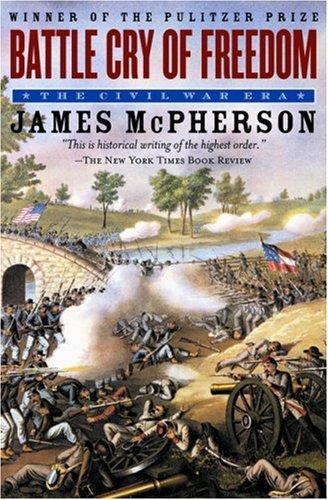
Battle Cry of Freedom: The Civil War Era by James M. McPherson is a 1988 history book about american civil war, slavery, political history. Slavery was not incidental to the Civil War but its central cause. The specific trigger was the question of whether slavery would be permitted in new western territories.
Summary
James McPherson's Battle Cry of Freedom, published in 1988, is the standard one-volume history of the Civil War era and won the Pulitzer Prize in the year of its publication. It covers the period from the 1840s through Appomattox, integrating political, economic, social, and military history in a way that most single-volume Civil War accounts do not attempt. McPherson is clear about what caused the war: slavery, and the specific conflict over its extension into new territories.
The book's first third covers the antebellum period — the Mexican War, the Kansas-Nebraska Act, the rise of the Republican Party, the disintegration of the Democratic Party, and the sequence of events that made secession feel like a viable option to Southern leaders by 1860. McPherson gives more weight to this pre-war political history than most narrative accounts do, and the payoff is that the war itself, when it arrives, feels like a logical outcome rather than a surprise. The book's military sections are detailed but never allow battles to crowd out political context.
McPherson argues throughout that the war's outcome was not predetermined. Contingency is his word: at multiple moments, different decisions by generals, presidents, or electorates could have produced different results. The 1864 election, in which Lincoln came close to losing to the peace candidate George McClellan, is given particular weight as a moment when the entire Union war effort nearly collapsed from within. Grant's campaigns in Virginia that summer, brutal as they were, were not just military operations but political interventions designed to keep the Northern electorate willing to continue.
The book ends at Appomattox and does not attempt to cover Reconstruction in detail. What it does accomplish is a coherent account of how a republic built on a contradiction — liberty and slavery coexisting — eventually had to resolve that contradiction by force, at a cost of 620,000 dead. McPherson writes with precision and without sentimentality, and the result is the most reliable starting point for anyone trying to understand what happened and why.
Talk to Battle Cry of Freedom: The Civil War Era like its author wrote you back.
Get the ideas that fit your life — not generic summaries.
- Chat with the book
- Audiobook-style main ideas
- Adapts to your life and goals
- Helps you take action
Key takeaways
- 1.
Slavery was not incidental to the Civil War but its central cause. The specific trigger was the question of whether slavery would be permitted in new western territories.
- 2.
The war's outcome was not inevitable. Lincoln nearly lost the 1864 election, and a Union peace settlement would likely have preserved Southern independence and slavery indefinitely.
- 3.
The Republican Party emerged in the 1850s specifically to oppose slavery's extension, uniting Northern interests that had previously been fragmented across multiple parties.
- 4.
The South's secession was driven by fear that Republican electoral success would eventually threaten slavery even in existing slave states, even though Lincoln had no immediate plan to do so.
- 5.
Northern military advantages in manpower and industry were large but not decisive by themselves — the Union also required political will to sustain a war of attrition, and that will nearly broke in 1864.
- 6.
Emancipation transformed the war's meaning internationally. After the Emancipation Proclamation, European powers that might have recognized the Confederacy faced a moral cost they were unwilling to pay.
- 7.
Black soldiers played a crucial military role in the war's final phase. Their enlistment expanded the Union's effective manpower and complicated Confederate morale.
- 8.
The Confederate political system, ironically, suffered from state-rights ideology: individual states resisted the centralization necessary to fight the war effectively, undermining the Confederate government at its weakest point.
Discussion questions
Use these on your own, with a book club, or as chat starters in Superbook. Book club version, ready to copy or print →
- 1.
McPherson argues that slavery, not tariffs or states' rights abstractly conceived, caused the war. How does that framing change what the war's outcome means?
- 2.
The book emphasizes contingency — the war could have gone differently at several points. Which moment in your reading felt most genuinely uncertain?
- 3.
Lincoln's handling of the border states — keeping them in the Union while deferring emancipation — is presented as political genius. Was it also a moral compromise, and does that distinction matter?
- 4.
McPherson gives significant attention to the antebellum period before the war begins. Did understanding that context change how you read the war itself?
- 5.
The 1864 election nearly ended the war on terms that would have preserved Confederate independence. How does that near-outcome change how you think about the war's resolution?
- 6.
Both sides claimed they were fighting for liberty. How does McPherson handle that paradox, and do you find his resolution satisfying?
- 7.
The Confederate leadership knew they were outgunned in industry and manpower. What was their theory for how they could win, and why did it ultimately fail?
- 8.
How does McPherson's treatment of slavery's centrality compare to other Civil War histories or popular accounts you've encountered?
- 9.
Black soldiers fought for a country that still denied them citizenship. What does McPherson say about how they understood that contradiction?
- 10.
The book ends at Appomattox without addressing Reconstruction. Does that feel like an appropriate stopping point, or an evasion?
- 11.
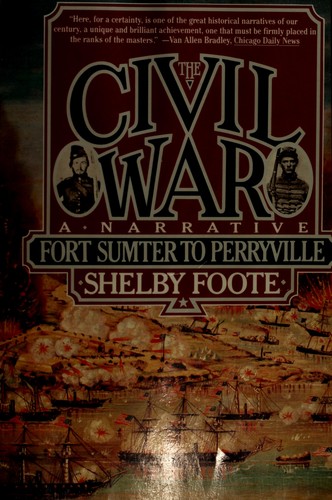
McPherson writes as a Princeton historian with strong scholarly standards. How does his approach differ in texture and argument from Shelby Foote's narrative trilogy?
- 12.
What does the Civil War era explain about American political institutions — the electoral college, the Senate, federalism — that is still relevant?
Themes
Frequently asked questions
-
Is Battle Cry of Freedom the best single-volume Civil War history?
It is the most widely recommended by professional historians and general readers alike. McPherson integrates political, social, and military history more thoroughly than most rivals. For readers who want one book on the subject, this is the standard recommendation.
-
How long does it take to read Battle Cry of Freedom?
The book runs to about 860 pages of text. At average reading pace that is roughly 30-35 hours. It is dense with detail but written accessibly enough that a committed general reader can move through it steadily.
-
What is Battle Cry of Freedom's main argument?
That slavery was the central cause of the Civil War, that the war's outcome was not predetermined, and that political will on both sides — especially the 1864 Northern election — was as decisive as military operations.
-
Does Battle Cry of Freedom cover Reconstruction?
No. The book ends at Appomattox in April 1865. McPherson has addressed Reconstruction in other works, but this volume is specifically about the war era, not its aftermath.
-
Who should read Battle Cry of Freedom?
Anyone who wants a rigorous, comprehensive account of the Civil War that takes slavery seriously as a cause. It rewards readers who want to understand the political context before the war, not just the battles.