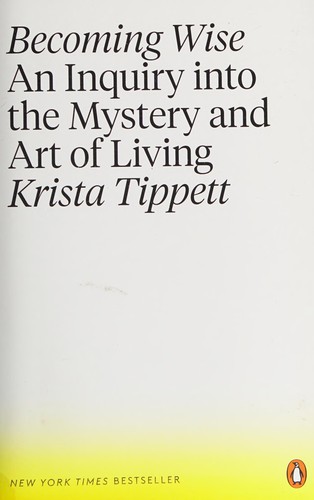
Talk to Becoming Wise: An Inquiry into the Mystery and Art of Living like its author wrote you back.
Get the ideas that fit your life — not generic summaries.
- Chat with the book
- Audiobook-style main ideas
- Adapts to your life and goals
- Helps you take action
Becoming Wise: An Inquiry into the Mystery and Art of Living, in detail
Becoming Wise draws on Krista Tippett's decades of conversation with scientists, poets, theologians, activists, and philosophers through her radio program On Being. The book is not a transcript of those conversations but a synthesis — Tippett's attempt to identify what the most thoughtful people she has encountered actually believe about how to live, and to find the patterns that cross disciplines and traditions.
The book is organized around themes rather than individuals: words, bodies, love, faith, hope. Each section is built around the ideas that emerged most persistently across hundreds of conversations. Tippett does not argue for a single framework; instead she documents the recurring insights of people who have thought hard about meaning, and she trusts the reader to find their own entry points. The effect is cumulative rather than argumentative.
What Tippett is most interested in is the quality of listening and the quality of asking. She writes at length about how the questions we bring to experience determine the quality of what we receive from it. This is not purely abstract: she is specific about the difference between questions that open and questions that close, about the difference between arguing and genuinely inquiring. She draws on conversations with figures like John Lewis, Mary Oliver, Thich Nhat Hanh, and Marilynne Robinson to show what serious, sustained attention to a question looks like.
The book has a hospitable rather than adversarial voice. It does not insist. Some critics find this quality too accommodating — it does not take hard positions on contested questions. But this is arguably the point. Tippett's method is to model a way of engaging with difficulty, not to resolve it. For readers who are already skeptical of easy answers, the book's lack of resolution feels like integrity.
The big ideas
- 1.
The questions we bring to experience determine the quality of what we receive. Better questions are often more valuable than answers.
- 2.
Wisdom is not a possession but a practice — developed through sustained attention to what matters and repeated exposure to different ways of being.
- 3.
Faith, as understood by the thinkers Tippett encounters, is not certainty. It is a willingness to act and relate from within uncertainty.
