Becoming Wise: An Inquiry into the Mystery and Art of Living by Krista Tippett is a 2016 philosophy book about wisdom, meaning, faith. The questions we bring to experience determine the quality of what we receive. Better questions are often more valuable than answers.
Summary
Becoming Wise draws on Krista Tippett's decades of conversation with scientists, poets, theologians, activists, and philosophers through her radio program On Being. The book is not a transcript of those conversations but a synthesis — Tippett's attempt to identify what the most thoughtful people she has encountered actually believe about how to live, and to find the patterns that cross disciplines and traditions.
The book is organized around themes rather than individuals: words, bodies, love, faith, hope. Each section is built around the ideas that emerged most persistently across hundreds of conversations. Tippett does not argue for a single framework; instead she documents the recurring insights of people who have thought hard about meaning, and she trusts the reader to find their own entry points. The effect is cumulative rather than argumentative.
What Tippett is most interested in is the quality of listening and the quality of asking. She writes at length about how the questions we bring to experience determine the quality of what we receive from it. This is not purely abstract: she is specific about the difference between questions that open and questions that close, about the difference between arguing and genuinely inquiring. She draws on conversations with figures like John Lewis, Mary Oliver, Thich Nhat Hanh, and Marilynne Robinson to show what serious, sustained attention to a question looks like.
The book has a hospitable rather than adversarial voice. It does not insist. Some critics find this quality too accommodating — it does not take hard positions on contested questions. But this is arguably the point. Tippett's method is to model a way of engaging with difficulty, not to resolve it. For readers who are already skeptical of easy answers, the book's lack of resolution feels like integrity.
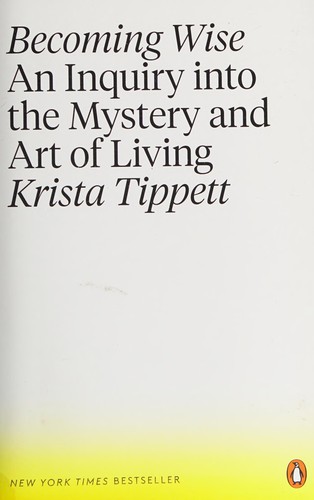
Talk to Becoming Wise: An Inquiry into the Mystery and Art of Living like its author wrote you back.
Get the ideas that fit your life — not generic summaries.
- Chat with the book
- Audiobook-style main ideas
- Adapts to your life and goals
- Helps you take action
Key takeaways
- 1.
The questions we bring to experience determine the quality of what we receive. Better questions are often more valuable than answers.
- 2.
Wisdom is not a possession but a practice — developed through sustained attention to what matters and repeated exposure to different ways of being.
- 3.
Faith, as understood by the thinkers Tippett encounters, is not certainty. It is a willingness to act and relate from within uncertainty.
- 4.
The body is not a container for the mind but a source of knowledge. Many of the wisest people Tippett interviews are deeply attentive to physical experience.
- 5.
Love, in its fullest sense, is a practice rather than a feeling — a sustained, chosen attention to the reality of another person or community.
- 6.
Hope is different from optimism. Optimism requires evidence; hope is a stance that continues in the absence of it. The distinction matters especially in dark periods.
- 7.
Generosity of interpretation — assuming people are doing their best with what they have — is not naivety. It is a discipline that opens rather than closes relationships.
- 8.
The capacity for genuine conversation — not debate, not information exchange, but mutual inquiry — is one of the rarest and most civilizing practices available.
Discussion questions
Use these on your own, with a book club, or as chat starters in Superbook. Book club version, ready to copy or print →
- 1.
Tippett says better questions are more valuable than answers. What is the most useful question you are currently living with — one you don't yet have an answer to?
- 2.
She draws on people from many religious and secular traditions. What did you notice about the differences and convergences between them?
- 3.
The book distinguishes hope from optimism. In your own life, is there something you are hoping for without being optimistic about? What is the difference in how that feels?
- 4.
Tippett writes about the quality of listening as a practice. When was the last time you felt genuinely listened to? What made it feel that way?
- 5.
Which of the thinkers she quotes had the most impact on you? Why that person in particular?
- 6.
Her method is cumulative — building a picture through many voices rather than a single argument. Did that approach work for you, or did you want more structure?
- 7.
The book treats faith as a stance within uncertainty, not a resolution of it. Does that definition of faith match or contradict how you've understood it?
- 8.
What does 'becoming wise' mean to you, and how does Tippett's conception match or diverge from yours?
- 9.
The section on love treats it as a practice rather than a feeling. What would it mean for you to practice love more deliberately in your closest relationships?
- 10.
Tippett describes encountering people who have been through significant suffering and emerged with more openness rather than less. What do you think makes that possible?
- 11.
If the book does not take hard positions on contested questions, is that a virtue or a form of avoidance? Where do you come down on that?
- 12.
Which theme — words, bodies, love, faith, hope — felt most alive for you in the book, and why?
Themes
Frequently asked questions
-
What is Becoming Wise about?
It synthesizes insights from Krista Tippett's years of conversations on her radio program On Being, drawing on scientists, poets, theologians, and activists to explore questions of meaning, faith, love, and how to live. The book is organized thematically rather than as a series of profiles.
-
Is Becoming Wise worth reading?
Yes, particularly for readers who value a meditative, accumulative approach to difficult questions. It is not a book of arguments but of assembled wisdom, and it works best on readers who are willing to be shaped by what they read rather than looking for conclusions.
-
Is Becoming Wise religious?
It engages seriously with religious and spiritual traditions but from a curious, nonsectarian perspective. Tippett grew up in the Southern Baptist tradition, but the book includes secular thinkers alongside religious ones. Non-religious readers are not excluded.
-
Who should read Becoming Wise?
Readers interested in the intersection of spirituality, science, and philosophy without wanting a dogmatic framework. Also readers who are mid-career or mid-life and asking questions about meaning and direction that their professional lives do not answer.
-
How long does it take to read Becoming Wise?
Around four to five hours at average pace. The chapters are not short but the prose is accessible. Many readers find it works better in slow, section-by-section reading than read straight through.
Similar books
Man's Search for Meaning
Viktor E. Frankl
When Breath Becomes Air
Paul Kalanithi
Four Thousand Weeks: Time Management for Mortals
Oliver Burkeman
The Examined Life: How We Lose and Find Ourselves
Stephen Grosz
