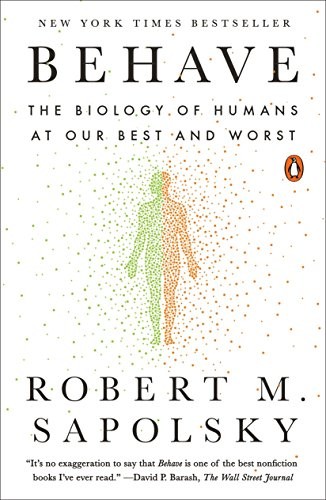
Talk to Behave: The Biology of Humans at Our Best and Worst like its author wrote you back.
Get the ideas that fit your life — not generic summaries.
- Chat with the book
- Audiobook-style main ideas
- Adapts to your life and goals
- Helps you take action
What it argues
Behave is Robert Sapolsky's attempt to explain why humans do what they do — the violence, the altruism, the tribalism, the heroism — by working through every layer of biology that contributes to a single act. The book begins in the second before a behavior occurs and then expands outward in time and scale: the hormone levels of the day, the neural architecture built over a lifetime, the childhood experiences that shaped it, the culture that framed it, the evolutionary pressures that built the whole system millions of years before the person was born. Sapolsky is a Stanford neurobiologist and primatologist, and the range he brings to the subject is unusually wide.
The structural move that makes the book work is also what makes it long. Rather than arguing a single thesis, Sapolsky systematically refuses to let any one level of analysis be the complete explanation. The amygdala matters, testosterone matters, childhood stress matters, intergroup dynamics matter, and moral philosophy matters — but none of them is the answer alone. The book's central insistence is that human behavior is multiply determined, that reductionism always misses something, and that anyone who reaches for a single cause (genes, culture, hormones) has stopped thinking too early.
What it gets right
- 1.
Every human behavior has biological causes operating across multiple timescales simultaneously — seconds (neurotransmitters), days (hormones), years (development), and millennia (evolution). Single-cause explanations are almost always wrong.
- 2.
The prefrontal cortex, which governs impulse control and long-term thinking, is the last brain region to fully mature — not until the mid-twenties — which helps explain adolescent risk-taking without excusing it.
- 3.
Testosterone doesn't produce aggression directly. It amplifies the motivation to respond to a perceived threat to status, which can mean fighting or appeasement depending on the context.
What it covers
Who wrote it
Robert M. Sapolsky is a professor of biology, neuroscience, and neurosurgery at Stanford University and a research associate at the National Museums of Kenya. He has spent decades studying stress physiology in baboons in East Africa and is one of the most widely read science writers working today. His other books include Why Zebras Don't Get Ulcers, A Primate's Memoir, and The Trouble with Testosterone. He is the recipient of a MacArthur Fellowship and has been recognized for his ability to make complex biological research accessible without oversimplifying it.
