Behave: The Biology of Humans at Our Best and Worst by Robert M. Sapolsky is a 2017 science book about human behavior, neuroscience, evolution. Every human behavior has biological causes operating across multiple timescales simultaneously — seconds (neurotransmitters), days (hormones), years (development), and millennia (evolution). Single-cause explanations are almost always wrong.
Summary
Behave is Robert Sapolsky's attempt to explain why humans do what they do — the violence, the altruism, the tribalism, the heroism — by working through every layer of biology that contributes to a single act. The book begins in the second before a behavior occurs and then expands outward in time and scale: the hormone levels of the day, the neural architecture built over a lifetime, the childhood experiences that shaped it, the culture that framed it, the evolutionary pressures that built the whole system millions of years before the person was born. Sapolsky is a Stanford neurobiologist and primatologist, and the range he brings to the subject is unusually wide.
The structural move that makes the book work is also what makes it long. Rather than arguing a single thesis, Sapolsky systematically refuses to let any one level of analysis be the complete explanation. The amygdala matters, testosterone matters, childhood stress matters, intergroup dynamics matter, and moral philosophy matters — but none of them is the answer alone. The book's central insistence is that human behavior is multiply determined, that reductionism always misses something, and that anyone who reaches for a single cause (genes, culture, hormones) has stopped thinking too early.
Much of the ground covered is genuinely counterintuitive. Testosterone doesn't cause aggression so much as it amplifies whatever behavior a status contest calls for — including prosocial behavior when that's what the situation demands. The same brain regions that process physical pain process social exclusion. The most reliable predictor of adult violence isn't genetics but early childhood adversity. Oxytocin, marketed as a universal bonding molecule, reliably increases favoritism toward in-groups and hostility toward out-groups. Sapolsky documents these complexities with a gift for analogy and an often sardonic wit that keeps 700 pages of neuroscience from feeling like a textbook.
The final chapters try to use all of this to examine punishment, free will, and what it would mean to hold people responsible for behavior that biology shaped so completely. Sapolsky is a determinist — he thinks free will as traditionally conceived doesn't survive the biological evidence — but he's careful about what follows from this. Abandoning free will doesn't mean abandoning accountability; it means redesigning systems that focus less on retribution and more on what actually changes behavior. The book won't resolve the free will debate, but it gives readers a richer account of the question than they came in with, and that's probably the right goal.
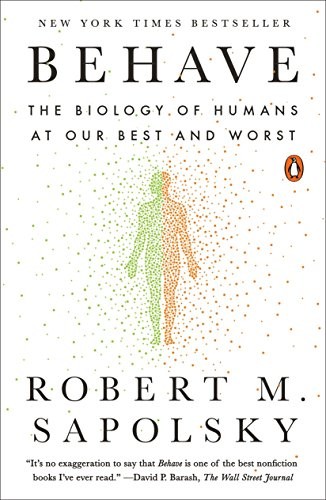
Talk to Behave: The Biology of Humans at Our Best and Worst like its author wrote you back.
Get the ideas that fit your life — not generic summaries.
- Chat with the book
- Audiobook-style main ideas
- Adapts to your life and goals
- Helps you take action
Key takeaways
- 1.
Every human behavior has biological causes operating across multiple timescales simultaneously — seconds (neurotransmitters), days (hormones), years (development), and millennia (evolution). Single-cause explanations are almost always wrong.
- 2.
The prefrontal cortex, which governs impulse control and long-term thinking, is the last brain region to fully mature — not until the mid-twenties — which helps explain adolescent risk-taking without excusing it.
- 3.
Testosterone doesn't produce aggression directly. It amplifies the motivation to respond to a perceived threat to status, which can mean fighting or appeasement depending on the context.
- 4.
Oxytocin is not simply a love hormone. Studies consistently show it increases in-group favoritism and out-group dehumanization simultaneously, making it as much a tribalism molecule as a bonding one.
- 5.
Early childhood adversity — abuse, neglect, chronic stress — rewires the stress-response system in ways that persist for decades and increase the risk of aggression, poor impulse control, and mental illness.
- 6.
The brain processes social pain (rejection, exclusion) using the same neural circuitry as physical pain. This is not metaphor — it's shared circuitry, which is why social injury feels real.
- 7.
Us-versus-them thinking is fast, automatic, and deeply embedded. The brain categorizes strangers by race in under 100 milliseconds, before conscious thought begins. Recognizing this doesn't make it go away, but it changes how you respond to the impulse.
- 8.
Sapolsky argues that free will as traditionally understood doesn't survive the biological evidence, but he draws a careful distinction: determinism doesn't imply fatalism, and understanding the causes of behavior is the most useful tool for changing it.
Discussion questions
Use these on your own, with a book club, or as chat starters in Superbook. Book club version, ready to copy or print →
- 1.
Sapolsky argues that behavior is always multiply determined. Which layer of explanation — genes, hormones, childhood, culture — do you most instinctively reach for when trying to explain someone's behavior, and why?
- 2.
The book documents how 'us vs. them' thinking is built into the brain at a level that operates before conscious awareness. Has knowing this ever actually changed how you responded to an in-group/out-group impulse?
- 3.
Sapolsky is a committed determinist. Does the biological account he gives of behavior change how you think about personal responsibility — your own or others'?
- 4.
The data on early childhood adversity and adult outcomes is stark. What obligations does that create for people and institutions who have the power to shape early childhood environments?
- 5.
Testosterone amplifies status-contest behavior rather than causing aggression directly. Does that nuance change how you think about testosterone's role in culture, institutions, or political life?
- 6.
Oxytocin increases both bonding and tribalism. Think of a time when in-group loyalty led you to treat an outsider worse than you otherwise would have. Was oxytocin doing its job there?
- 7.
The prefrontal cortex isn't fully developed until the mid-twenties. How much of that do you factor into how you judge the behavior of teenagers and young adults — people you know personally or public figures?
- 8.
Sapolsky says the most important intervention for reducing violence is improving early childhood conditions. Do you think the systems and institutions you live inside actually act on that knowledge?
- 9.
The book covers moral philosophy in the last section — Kantian ethics, utilitarianism, Rawlsian justice — and tries to evaluate them in light of the biology. Which framework holds up best under that scrutiny, in your view?
- 10.
Sapolsky documents how context shifts behavior dramatically — the same person in different situations. Think of a time when your behavior was much worse (or much better) than your self-image would predict. What was the context doing?
- 11.
The book argues that punishment systems built on retribution are less effective than ones built on changing the conditions that produce behavior. Where do you see that tension playing out in policy debates you follow?
- 12.
Sapolsky writes with open advocacy at some points — on capital punishment, on how we treat the mentally ill, on free will. Does an author's explicit moral position help or hurt a science book for you?
Themes
Frequently asked questions
-
Is Behave worth reading?
Yes, if you want a serious account of what biology actually says about human behavior. It's long and dense in places, but Sapolsky earns the length — the argument requires the accumulation. Readers who like Malcolm Gladwell but want more rigor, or who like Kahneman but want more evolutionary and neurobiological depth, will find it rewarding.
-
How long does it take to read Behave?
Roughly 15 hours at an average reading pace for the 790-page book. It's not a book most people finish in a single stretch. The chapter structure makes it workable in sections — each chapter covers a distinct timescale or system and can be absorbed independently.
-
What is Behave mainly about?
Why humans do what they do, examined through every layer of biology that contributes to behavior: neurotransmitters, hormones, brain development, genetics, childhood environment, culture, and evolution. Sapolsky's core argument is that any single-cause explanation misses how thoroughly multiply determined human behavior is.
-
Who should read Behave?
People interested in psychology, neuroscience, or evolutionary biology who want a unified account rather than a single-focus book. It rewards readers who already have some background in one of those fields and want to understand how the others connect. It's also useful for anyone thinking seriously about criminal justice, morality, or political tribalism.
-
What's the most surprising finding in the book?
Probably the oxytocin research. Most people have absorbed the idea that oxytocin is a bonding and trust molecule. Sapolsky documents that the same release of oxytocin that increases bonding with your in-group reliably increases hostility and dehumanization toward out-groups. The molecule isn't about love — it's about the boundaries of love.
Similar books
Thinking, Fast and Slow
Daniel Kahneman
The Righteous Mind: Why Good People Are Divided by Politics and Religion
Jonathan Haidt

Sapiens: A Brief History of Humankind
Yuval Noah Harari
The Selfish Gene
Richard Dawkins
