Talk to Bewilderment like its author wrote you back.
Get the ideas that fit your life — not generic summaries.
- Chat with the book
- Audiobook-style main ideas
- Adapts to your life and goals
- Helps you take action
What it argues
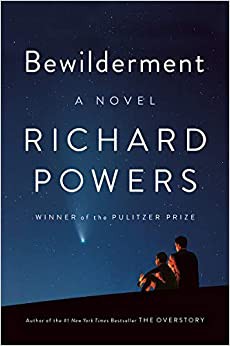
Bewilderment centers on Theo Byrne, an astrobiologist at the University of Wisconsin, and his nine-year-old son Robin, who is grieving the recent death of his mother and struggling with emotional and behavioral dysregulation that the school and medical establishment want to treat with drugs. Theo, opposed to medicating his son, enrolls Robin in a neurofeedback trial that uses recordings of his mother's brain patterns to reshape Robin's neural responses. The treatment works, transforming Robin into a prodigy of emotional attunement — and bringing him into increasing contact with the ecological crisis that is destroying the natural world he loves.
The novel is a father-son love story of genuine emotional power, but it is also a meditation on extinction and what it costs to pay attention to it. Powers spent years thinking about the Overstory — his Pulitzer-winning novel about trees — and Bewilderment can be read as its companion piece: a novel about what it feels like to watch the world you love being destroyed, and to have a child who feels it even more acutely. Robin becomes a kind of climate saint — his neurofeedback-enhanced empathy makes him feel the loss of species with almost physical intensity — and the novel asks what it does to a person (and what it does to a father) to be that sensitive in an insensate world.
What it gets right
- 1.
Neurofeedback that uses a dead person's brain patterns raises real questions about identity, grief, and what it means to carry someone's consciousness forward.
- 2.
Robin's transformation into an emotionally attuned prodigy is not presented as pure gain — the cost of feeling the world's pain with that clarity is real and specific.
- 3.
The novel draws a direct line between the political dismantling of environmental regulation and the conditions Robin is responding to. Powers is not subtle about this.
What it covers
Who wrote it
Richard Powers is an American novelist known for fiction that weaves together scientific research and humanist concern. His twelve novels include The Echo Maker, which won the National Book Award; The Overstory, which won the Pulitzer Prize for Fiction in 2019; and Bewilderment. He studied physics before turning to literature, and his work characteristically draws on advances in biology, neuroscience, and ecology. Powers is one of the most decorated American novelists of his generation, and his fiction is notable for the scale of its intellectual ambition and the emotional seriousness with which it treats scientific ideas.
