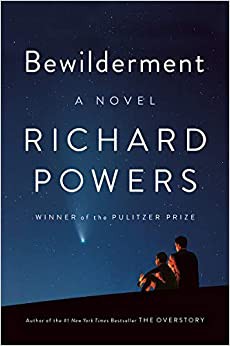
Bewilderment by Richard Powers is a 2021 literary fiction book about climate grief, neuroscience and consciousness, father and child. Neurofeedback that uses a dead person's brain patterns raises real questions about identity, grief, and what it means to carry someone's consciousness forward.
Summary
Bewilderment centers on Theo Byrne, an astrobiologist at the University of Wisconsin, and his nine-year-old son Robin, who is grieving the recent death of his mother and struggling with emotional and behavioral dysregulation that the school and medical establishment want to treat with drugs. Theo, opposed to medicating his son, enrolls Robin in a neurofeedback trial that uses recordings of his mother's brain patterns to reshape Robin's neural responses. The treatment works, transforming Robin into a prodigy of emotional attunement — and bringing him into increasing contact with the ecological crisis that is destroying the natural world he loves.
The novel is a father-son love story of genuine emotional power, but it is also a meditation on extinction and what it costs to pay attention to it. Powers spent years thinking about the Overstory — his Pulitzer-winning novel about trees — and Bewilderment can be read as its companion piece: a novel about what it feels like to watch the world you love being destroyed, and to have a child who feels it even more acutely. Robin becomes a kind of climate saint — his neurofeedback-enhanced empathy makes him feel the loss of species with almost physical intensity — and the novel asks what it does to a person (and what it does to a father) to be that sensitive in an insensate world.
Powers writes literary fiction that is also science fiction, in the sense that his scientific premises are speculative but disciplined. The neurofeedback technology in the novel does not exist as described, but it is extrapolated from real cognitive science in ways that feel plausible. His astrobiology background gives the novel a secondary layer — Theo's work on imagined exoplanets, their theoretical ecologies, runs parallel to Robin's relationship with the ecology of this one. The novel's structural conceit is elegant: the worlds Theo imagines that might have life are a dark mirror of the world that is losing it.
Bewilderment will divide readers. Those who find The Overstory's earnestness about ecological crisis moving will find much to love here — it is a warmer, more intimate novel than its predecessor. Those who find ecological fiction preachy will find Bewilderment even more so, since it adds a child saint to the formula. But the father-son relationship is written with genuine specificity and grief, and Powers earns more emotional weight here than in any of his previous work.
Talk to Bewilderment like its author wrote you back.
Get the ideas that fit your life — not generic summaries.
- Chat with the book
- Audiobook-style main ideas
- Adapts to your life and goals
- Helps you take action
Key takeaways
- 1.
Neurofeedback that uses a dead person's brain patterns raises real questions about identity, grief, and what it means to carry someone's consciousness forward.
- 2.
Robin's transformation into an emotionally attuned prodigy is not presented as pure gain — the cost of feeling the world's pain with that clarity is real and specific.
- 3.
The novel draws a direct line between the political dismantling of environmental regulation and the conditions Robin is responding to. Powers is not subtle about this.
- 4.
Theo's astrobiological thought experiments — imagining what life might look like on other worlds — serve as an elegy for what is being lost on this one.
- 5.
The father-son relationship is the emotional core and it is written with unusual tenderness. Powers is more interested in love here than in almost any of his previous novels.
- 6.
Climate grief as a psychological phenomenon — not just anxiety about the future but specific grief about ongoing extinction — is given serious literary treatment.
- 7.
The tension between Theo's role as a father protecting Robin and his role as an adult who understands the scale of what Robin is responding to is the novel's central dramatic tension.
- 8.
The ending is devastating in a way that feels earned. Powers does not protect the reader from the consequences of the world the novel has built.
Discussion questions
Use these on your own, with a book club, or as chat starters in Superbook. Book club version, ready to copy or print →
- 1.
Robin's neurofeedback uses recordings of his dead mother's brain. Is that treatment presented as healing, or as something more troubling — a form of resurrection that prevents real grief?
- 2.
Theo opposes medicating Robin but agrees to experimental neurofeedback. Is that distinction morally coherent, or is it a form of motivated reasoning?
- 3.
The novel's political villain — a deregulatory, science-denying president — is thinly drawn. Does the thinness weaken the novel's critique, or does it serve the parable?
- 4.
Robin becomes a face of the environmental movement. What does the novel say about the use of children in political causes — and is it asking us to endorse that use or question it?
- 5.
Compare Bewilderment to The Overstory. Does the intimate, personal scale make the ecological argument more or less effective?
- 6.
The astrobiological thought experiments that run through the novel imagine life on other planets. Did those passages work for you — do they add meaning or slow the narrative?
- 7.
Theo is often paralyzed by grief and fear for his son. Is he a good father? Does the novel want us to judge him or sympathize with him?
- 8.
The novel is quite short by Powers' standards. Does the compression serve it, or does it feel like ideas that needed more space?
- 9.
Robin's enhanced empathy allows him to feel what other creatures feel. Is that a realistic extrapolation from the neurofeedback premise, or is the novel asking for a leap of faith?
- 10.
The ending offers no comfort. Did you feel that was honest, or did you find it punishing?
- 11.
Powers has been criticized for writing characters who exist primarily to embody ideas. Does that criticism apply to Robin and Theo, or do they feel like people?
- 12.
What does it mean that Robin's movement fails? Is the novel pessimistic about political action, or is it saying something more specific about the politics of the moment?
Themes
Frequently asked questions
-
Is Bewilderment worth reading?
Yes, especially if you've read and loved The Overstory — Bewilderment covers similar thematic ground in a more intimate register. The father-son relationship is written with genuine emotional specificity, and the neuroscience conceit is more than just a narrative device. Readers who found The Overstory too diffuse may prefer this more focused version.
-
Is Bewilderment preachy about climate change?
It's earnest rather than preachy — there's a difference. Powers is deeply convinced of the urgency of ecological crisis and the novel makes no pretense otherwise. Readers who share that conviction will find it moving. Readers who find climate fiction didactic will likely find this too.
-
Do I need to read The Overstory first?
No. Bewilderment is a standalone novel. But readers who've read The Overstory will recognize common concerns and may appreciate how Powers develops them differently in a more intimate form.
-
How does the neurofeedback science in Bewilderment work?
In the novel, a deceased researcher's brain recordings are used to guide a patient's neural patterns toward states of greater emotional regulation. The technology is speculative but extrapolated from real neurofeedback research. Powers is careful to signal that it doesn't exist as described.
-
Who shouldn't read Bewilderment?
Readers who want emotional distance from climate themes — the novel is saturated with ecological grief. Also readers who find Powers' tendency to write characters as idea-carriers frustrating; Robin in particular is very close to an emblem rather than a fully individuated child.