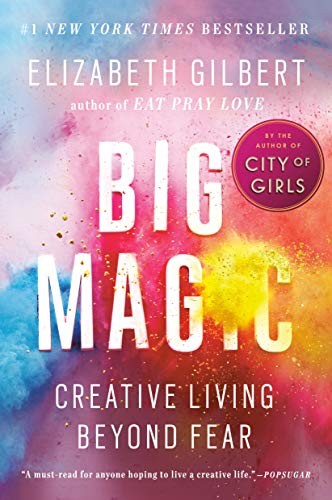
Talk to Big Magic like its author wrote you back.
Get the ideas that fit your life — not generic summaries.
- Chat with the book
- Audiobook-style main ideas
- Adapts to your life and goals
- Helps you take action
What it argues
Big Magic is Elizabeth Gilbert's manifesto for living a creative life — not as a professional artistic career but as an orientation toward existence. The book is warm, direct, and deliberately anti-perfectionist. Gilbert's argument is that the primary obstacle to creative living is not lack of talent or time but fear, and that the proper response to fear is not to overcome it but to bring it along as a passenger while moving forward anyway.
The book is organized around six concepts: Courage, Enchantment, Permission, Persistence, Trust, and Divinity. Gilbert argues that creative ideas exist as entities with their own energy, moving through the world looking for a willing human host. Whether or not you accept this as literal, the implication is clear: ideas find people who are ready to receive them and move on when those people fail to act. This explains why two people sometimes arrive at similar ideas simultaneously — the idea found a second host when the first one hesitated.
What it gets right
- 1.
Fear is the constant companion of creative work, not an absence to be overcome. The productive approach is to acknowledge it and create anyway, not to wait until it's gone.
- 2.
Permission to create does not require credentials, mastery, or external validation. Granting yourself permission is the first and most important step.
- 3.
Curiosity is more sustainable than passion as a creative guide. Following what you find interesting — even modestly — leads to more sustained engagement than chasing burning purpose.
What it covers
Who wrote it
Elizabeth Gilbert is the American author of Eat Pray Love (2006), which sold more than ten million copies and was adapted into a major film. She has also written novels, short stories, and nonfiction. Big Magic, published in 2015, reflects years of thinking and speaking about creativity, fear, and what makes a creative life. She hosts the podcast Magic Lessons with Elizabeth Gilbert. Her work is characterized by warmth, honesty about her own struggles, and a commitment to making creativity accessible to non-professionals.
