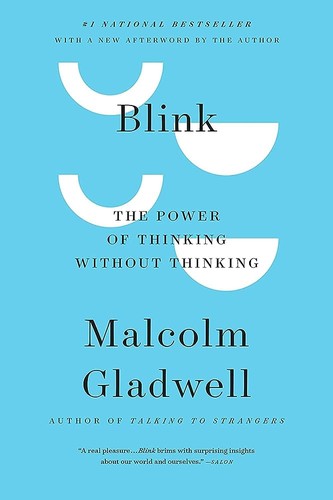
Talk to Blink: The Power of Thinking Without Thinking like its author wrote you back.
Get the ideas that fit your life — not generic summaries.
- Chat with the book
- Audiobook-style main ideas
- Adapts to your life and goals
- Helps you take action
What it argues
Blink is Malcolm Gladwell's argument that fast, unconscious decisions — the ones made in the first two seconds of encountering something — are often just as reliable as slow, deliberate analysis, and sometimes more so. Gladwell calls this the "adaptive unconscious": a mental system that processes the world rapidly, drawing on pattern recognition built up through years of experience. The book's central claim is that snap judgments deserve more credit, more scrutiny, and more careful management than they usually get. Most people dismiss intuition as mere guesswork or treat it as categorically inferior to data-gathering and deliberate thought. Gladwell's case is that it operates through a genuine cognitive process — one that can be cultivated deliberately, and one that can fail in predictable, diagnosable ways.
Gladwell builds his argument with a series of vivid examples. Art experts who immediately sense a forgery before they can articulate why. A tennis coach who can predict a double fault before the ball leaves the racket. A psychologist named John Gottman who predicts whether a married couple will divorce from fifteen minutes of conversation with near-perfect accuracy. In each case, the expert's blink was more reliable than laboriously gathered data — because the thin-slicing of relevant cues, something the unconscious does automatically, cuts through the noise that deliberate analysis tends to accumulate. The Getty kouros, a marble statue that passed months of scientific testing and fooled many credentialed experts, failed the first-glance test for several others. That story opens the book and keeps returning as a puzzle: what did those people actually perceive?
What it gets right
- 1.
The adaptive unconscious processes vast amounts of information rapidly and below conscious awareness, often producing judgments that are faster and sometimes more accurate than deliberate analysis.
- 2.
Thin-slicing — drawing reliable conclusions from a thin slice of experience — is a real cognitive ability. Experts in many fields can read situations accurately from brief exposure.
- 3.
The conditions for accurate intuition are expertise in a specific domain and a well-defined set of relevant cues. Outside those conditions, speed produces confident errors, not insight.
What it covers
Who wrote it
Malcolm Gladwell is a Canadian journalist, author, and podcaster. He spent nearly a decade as a staff writer at The New Yorker before becoming a full-time author, and he continues to contribute there. He is the author of six books, including The Tipping Point, Outliers, What the Dog Saw, David and Goliath, and The Bomber Mafia, most of which have reached the top of The New York Times bestseller list. His podcast Revisionist History reexamines overlooked or misunderstood events in history. He grew up in Ontario, Canada.
