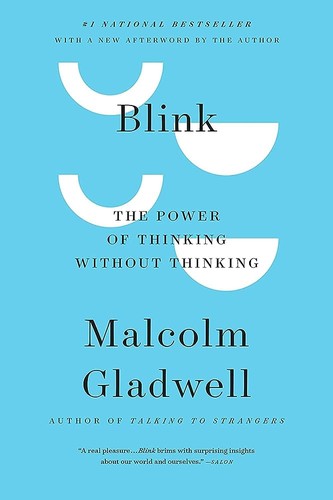
Blink: The Power of Thinking Without Thinking by Malcolm Gladwell is a 2005 psychology book about intuition, decision-making, unconscious cognition. The adaptive unconscious processes vast amounts of information rapidly and below conscious awareness, often producing judgments that are faster and sometimes more accurate than deliberate analysis.
Summary
Blink is Malcolm Gladwell's argument that fast, unconscious decisions — the ones made in the first two seconds of encountering something — are often just as reliable as slow, deliberate analysis, and sometimes more so. Gladwell calls this the "adaptive unconscious": a mental system that processes the world rapidly, drawing on pattern recognition built up through years of experience. The book's central claim is that snap judgments deserve more credit, more scrutiny, and more careful management than they usually get. Most people dismiss intuition as mere guesswork or treat it as categorically inferior to data-gathering and deliberate thought. Gladwell's case is that it operates through a genuine cognitive process — one that can be cultivated deliberately, and one that can fail in predictable, diagnosable ways.
Gladwell builds his argument with a series of vivid examples. Art experts who immediately sense a forgery before they can articulate why. A tennis coach who can predict a double fault before the ball leaves the racket. A psychologist named John Gottman who predicts whether a married couple will divorce from fifteen minutes of conversation with near-perfect accuracy. In each case, the expert's blink was more reliable than laboriously gathered data — because the thin-slicing of relevant cues, something the unconscious does automatically, cuts through the noise that deliberate analysis tends to accumulate. The Getty kouros, a marble statue that passed months of scientific testing and fooled many credentialed experts, failed the first-glance test for several others. That story opens the book and keeps returning as a puzzle: what did those people actually perceive?
But the book is equally interested in when rapid cognition fails. Implicit bias, first impressions that reinforce existing prejudice, and the interference of too much information all corrupt the signal. The Warren Harding Effect — how Harding was elected president partly because he looked the part — is Gladwell's cautionary example for how involuntarily we can be swayed by irrelevant cues. Musicians auditioning behind a screen perform differently than those seen in person. Police officers make different split-second judgments depending on context and priming. The conditions that produce accurate blinks are expertise and a narrow, well-defined domain. Outside those conditions, the same speed that enables expert insight produces confident errors at the same velocity.
What Gladwell does well is make the unconscious legible through story. The science he draws on — particularly the work of John Gottman, Nalini Ambady, and Paul Ekman's FACS system for reading microexpressions — is real and worth knowing. The book has attracted criticism for selective use of studies and for overstating how cleanly lessons transfer between contexts: a war commander reading a battlefield and a hiring manager reading a resume are not equivalent blinks. Readers looking for a clean prescription will find less here than in Gladwell's other books. The stronger takeaway is epistemological — an invitation to ask, in any given situation, whether slowing down would add information or just add noise, and whether the instinct being trusted was built in the right domain to deserve trust.
Talk to Blink: The Power of Thinking Without Thinking like its author wrote you back.
Get the ideas that fit your life — not generic summaries.
- Chat with the book
- Audiobook-style main ideas
- Adapts to your life and goals
- Helps you take action
Key takeaways
- 1.
The adaptive unconscious processes vast amounts of information rapidly and below conscious awareness, often producing judgments that are faster and sometimes more accurate than deliberate analysis.
- 2.
Thin-slicing — drawing reliable conclusions from a thin slice of experience — is a real cognitive ability. Experts in many fields can read situations accurately from brief exposure.
- 3.
The conditions for accurate intuition are expertise in a specific domain and a well-defined set of relevant cues. Outside those conditions, speed produces confident errors, not insight.
- 4.
Too much information can degrade judgment. Studies show that adding data beyond a certain point increases confidence without improving accuracy, and sometimes reduces it.
- 5.
Implicit bias operates through the same unconscious channels as expert intuition. First impressions that feel neutral often encode race, gender, and appearance cues that have nothing to do with the question being decided.
- 6.
The Warren Harding Effect: people who look the part get selected for the part. Irrelevant physical and social cues — height, voice, appearance — shape snap judgments in ways we rarely acknowledge.
- 7.
Priming and context corrupt rapid cognition. The same person makes different split-second decisions depending on what they were thinking about moments before.
- 8.
Structured intervention can reduce bias in snap judgments. Blind auditions, anonymized applications, and other tools that remove irrelevant cues improve outcomes without slowing the process.
Discussion questions
Use these on your own, with a book club, or as chat starters in Superbook. Book club version, ready to copy or print →
- 1.
Gladwell argues the adaptive unconscious is a powerful decision-making tool. What is a domain in your life where you trust your gut more than your reasoning — and is that trust earned?
- 2.
Think of a time your first impression of a person or situation turned out to be wrong. What cues were you reading that misled you?
- 3.
The book distinguishes between blinks built on genuine expertise and blinks built on unconscious bias. How would you tell the difference in your own snap judgments?
- 4.
Gottman claims to predict divorce from watching a few minutes of a couple talking. What does this suggest about how much we reveal when we think we are presenting ourselves well?
- 5.
The Getty Museum bought a fake kouros partly because the authentication process generated so much data that doubt felt unreasonable. When has accumulating more information made a decision harder rather than easier for you?
- 6.
Gladwell says musicians auditioned behind a screen performed better on average. Where in your professional life is an equivalent screen missing — something that would force evaluation on the right criteria?
- 7.
The Warren Harding Effect suggests that looking the part matters more than we want to admit. Which decisions in your life might be influenced by someone simply seeming correct for a role?
- 8.
Gladwell describes how police officers under extreme stress sometimes make tragic errors because their unconscious reads threat cues incorrectly. What high-stakes situations in your own life require slowing down an instinct rather than following it?
- 9.
The book suggests that experts sometimes cannot explain their best judgments. When you have acted on a feeling that you could not articulate, how did you decide whether to trust it?
- 10.
Gladwell criticizes over-reliance on thick data in areas like market research. Is there a domain where you think your organization or field gathers too much data and ignores better-calibrated intuition?
- 11.
If thin-slicing works because it filters out noise, what noise are you currently allowing into decisions that would be sharper without it?
- 12.
Blink spends significant time on cases where intuition fails catastrophically. Does knowing the failure modes change how much you trust your own quick judgments?
Themes
Frequently asked questions
-
What is Blink about?
Blink examines rapid, unconscious decision-making — what Gladwell calls "thin-slicing." The book argues that split-second judgments can be highly accurate when they come from genuine expertise, and dangerously unreliable when they draw on bias or irrelevant cues. The central question is when to trust fast thinking and when to slow down.
-
Is Blink worth reading?
Yes, especially if you are interested in how decisions actually get made. The stories are engaging and the core ideas about expertise, bias, and thin-slicing are genuinely useful. The book has been criticized for oversimplifying the science, and it offers fewer practical tools than Gladwell's other books — but it remains one of the more readable introductions to unconscious cognition.
-
How long does it take to read Blink?
Around five to six hours at average pace for the 254-page book. The chapters move quickly and Gladwell's narrative style keeps pages turning. Many readers finish it in a weekend.
-
What is thin-slicing?
Thin-slicing is the ability to draw accurate conclusions from a small window of experience — a brief interaction, a few seconds of video, a quick glance at a room. Gladwell argues that the unconscious does this automatically, and that in the right conditions, the resulting judgment is more reliable than analysis using much larger data sets.
-
How does Blink relate to Thinking, Fast and Slow?
Kahneman's book covers similar territory — System 1 (fast, automatic) versus System 2 (slow, deliberate) thinking — but is more rigorous and more skeptical of rapid cognition. Gladwell is more optimistic about intuition and writes for a general audience. Thinking, Fast and Slow is a better scientific account; Blink is a more entertaining first encounter with the ideas.