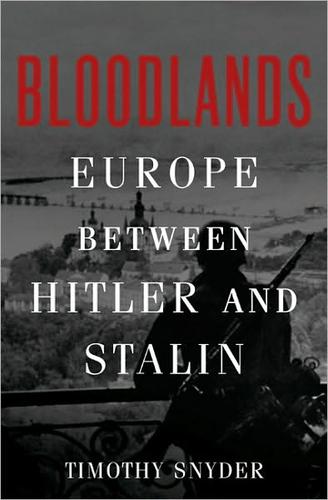
Talk to Bloodlands: Europe Between Hitler and Stalin like its author wrote you back.
Get the ideas that fit your life — not generic summaries.
- Chat with the book
- Audiobook-style main ideas
- Adapts to your life and goals
- Helps you take action
What it argues
Bloodlands is Timothy Snyder's account of the territories between Nazi Germany and the Soviet Union — principally Poland, Ukraine, Belarus, and the Baltic states — where the two regimes' violence overlapped between 1933 and 1945. In this zone, which Snyder calls the bloodlands, fourteen million people were deliberately killed in a little over a decade. Snyder's central intervention is to treat Nazi and Soviet mass murder together, in the same geographic and chronological frame, rather than as separate histories studied by separate scholarly traditions.
The book opens with the Soviet famine in Ukraine in 1932–33, the Holodomor, in which roughly 3.3 million Ukrainians were starved to death as a matter of deliberate policy. It then moves through the Soviet mass shootings of 1937–38, the German-Soviet cooperation of 1939–41, the German invasion of the Soviet Union, and the unfolding of the Holocaust on Eastern European soil. Snyder is particularly careful to distinguish different categories of killing: starvation as policy, execution by shooting, the gas chambers, and the deliberate starvation of Soviet prisoners of war. Each method has its own logic and its own perpetrators.
What it gets right
- 1.
Fourteen million people were deliberately killed in the bloodlands between 1933 and 1945, the majority before the Holocaust began and many by the Soviet regime.
- 2.
Treating Nazi and Soviet violence separately distorts our understanding of both. They overlapped in time, place, and method, and each regime's choices were shaped by the other's presence.
- 3.
The Holodomor — the deliberate Soviet starvation of Ukraine in 1932–33 — was a mass killing event comparable in scale to many phases of the Holocaust and should be understood as such.
What it covers
Who wrote it
Timothy Snyder is the Richard C. Levin Professor of History at Yale University and a permanent fellow at the Institute for Human Sciences in Vienna. He is the author of more than ten books on Eastern European history and political thought, including On Tyranny, The Road to Unfreedom, and Black Earth. Snyder reads more than a dozen languages and has conducted research in archives across Eastern Europe. He is widely regarded as one of the leading historians of modern European state violence and totalitarianism.
