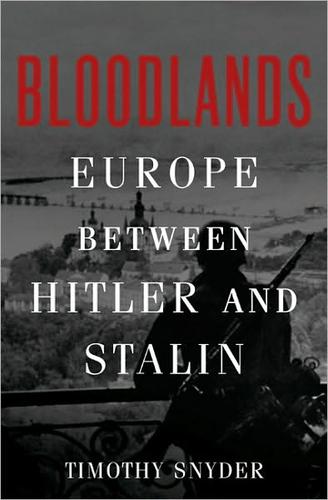
Bloodlands: Europe Between Hitler and Stalin by Timothy Snyder is a 2010 history book about mass killing, totalitarianism, state violence. Fourteen million people were deliberately killed in the bloodlands between 1933 and 1945, the majority before the Holocaust began and many by the Soviet regime.
Summary
Bloodlands is Timothy Snyder's account of the territories between Nazi Germany and the Soviet Union — principally Poland, Ukraine, Belarus, and the Baltic states — where the two regimes' violence overlapped between 1933 and 1945. In this zone, which Snyder calls the bloodlands, fourteen million people were deliberately killed in a little over a decade. Snyder's central intervention is to treat Nazi and Soviet mass murder together, in the same geographic and chronological frame, rather than as separate histories studied by separate scholarly traditions.
The book opens with the Soviet famine in Ukraine in 1932–33, the Holodomor, in which roughly 3.3 million Ukrainians were starved to death as a matter of deliberate policy. It then moves through the Soviet mass shootings of 1937–38, the German-Soviet cooperation of 1939–41, the German invasion of the Soviet Union, and the unfolding of the Holocaust on Eastern European soil. Snyder is particularly careful to distinguish different categories of killing: starvation as policy, execution by shooting, the gas chambers, and the deliberate starvation of Soviet prisoners of war. Each method has its own logic and its own perpetrators.
One of Snyder's most important arguments concerns what the Holocaust actually looked like on the ground. Most of the Jewish victims of the Nazi genocide were not gassed in camps. They were shot in fields and forests in the east, often by local police forces, often in front of their neighbors. Auschwitz became the iconic site of the Holocaust largely because its survivors were disproportionately Western European Jews who lived to testify. The bloodlands Jews left far fewer witnesses.
Bloodlands is demanding and deliberately unflinching. Snyder ends each chapter with individual names and stories, refusing to let the statistics remain abstract. The book is not a comparative study of totalitarianism in the philosophical sense but a geographic and chronological reckoning with what two ideological systems produced when they competed for control of the same territory and the same people.
Talk to Bloodlands: Europe Between Hitler and Stalin like its author wrote you back.
Get the ideas that fit your life — not generic summaries.
- Chat with the book
- Audiobook-style main ideas
- Adapts to your life and goals
- Helps you take action
Key takeaways
- 1.
Fourteen million people were deliberately killed in the bloodlands between 1933 and 1945, the majority before the Holocaust began and many by the Soviet regime.
- 2.
Treating Nazi and Soviet violence separately distorts our understanding of both. They overlapped in time, place, and method, and each regime's choices were shaped by the other's presence.
- 3.
The Holodomor — the deliberate Soviet starvation of Ukraine in 1932–33 — was a mass killing event comparable in scale to many phases of the Holocaust and should be understood as such.
- 4.
Most victims of Nazi mass murder were shot in the open, not gassed in camps. The camp-centric image of the Holocaust reflects the survival of Western European Jewish witnesses more than it reflects the geography of the killing.
- 5.
Local collaboration was essential to the Nazi murder of Jews in the east. This fact is uncomfortable but documented, and it complicates national memory in Poland, Ukraine, and the Baltic states.
- 6.
Both regimes used food as a weapon. The deliberate starvation of populations — Ukrainian peasants, Soviet prisoners of war, besieged cities — was a feature of both totalitarianisms.
- 7.
Stalin's Great Terror of 1937–38 killed approximately 700,000 Soviet citizens, disproportionately targeting Poles and other national minorities inside the Soviet Union.
- 8.
Memory of the killing was suppressed under Soviet rule. Many sites of mass murder in the bloodlands were not publicly acknowledged until after 1991, and some remain contested today.
Discussion questions
Use these on your own, with a book club, or as chat starters in Superbook. Book club version, ready to copy or print →
- 1.
Snyder argues that studying Nazi and Soviet violence separately distorts both histories. What do we gain and what do we risk by comparing them so directly?
- 2.
The Holodomor is sometimes called a genocide and sometimes described as a man-made famine. What does the distinction matter, practically and morally?
- 3.
Snyder shows that the perpetrators of mass murder were often ordinary people — local police, farmers, administrators. What does this suggest about the conditions that enable mass killing?
- 4.
Most Holocaust victims were shot rather than gassed. Why do you think the camp-centric image of the Holocaust became dominant in postwar memory, and what does that emphasis miss?
- 5.
How should nations that participated in or witnessed mass killing — Poland, Ukraine, Germany — construct public memory of events in which their own citizens were both victims and perpetrators?
- 6.
Snyder ends many chapters with individual names and stories. Why does this technique matter in a book that is otherwise about aggregate statistics?
- 7.
The two regimes cooperated under the Molotov-Ribbentrop Pact from 1939 to 1941. How does this cooperation complicate the standard narrative of World War II as a war between fascism and its opponents?
- 8.
Snyder describes a competition between two ideologies for control of the same people and land. In what ways did this competition intensify the violence, and in what ways did ideology provide cover for older patterns of ethnic conflict?
- 9.
The bloodlands are now independent states. How does the history Snyder describes shape politics and national identity in Ukraine, Poland, and the Baltic states today?
- 10.
What are the risks of writing history that emphasizes perpetrators and methods rather than survivors' experiences? What are the risks of the opposite approach?
- 11.
Snyder argues that numbers without names are dangerous. Do you agree? Is there a point at which the emphasis on individual stories obscures patterns that only statistics can reveal?
- 12.
The deliberate starvation of Soviet prisoners of war killed roughly 3.3 million men. This is less well known than other elements of the Second World War. Why do some mass deaths receive sustained historical attention while others are obscured?
Themes
Frequently asked questions
-
What is the main argument of Bloodlands?
That the territories between Nazi Germany and the Soviet Union — principally Ukraine, Poland, Belarus, and the Baltics — saw fourteen million deliberate killings between 1933 and 1945, carried out by both regimes. Snyder argues these two histories must be studied together to be understood.
-
Is Bloodlands appropriate for general readers?
It is written for a general audience but is not easy reading. The material is systematically brutal and Snyder does not soften it. Readers who want historical grounding without a prior familiarity with Eastern European history will find it accessible but demanding.
-
How does Bloodlands change how we understand the Holocaust?
Snyder shows that the majority of Holocaust victims were shot in the fields and forests of the east, not gassed in camps. The camp-centric image of the genocide reflects where survivors happened to come from, not where most killing occurred.
-
How long is Bloodlands?
Around 400 pages of text plus notes and bibliography. At average reading pace it takes roughly seven to eight hours. The chapters are organized chronologically and thematically, so readers can also approach it in sections.
-
Does Bloodlands compare Stalin and Hitler?
It does, but carefully. Snyder focuses on geographic and chronological overlap rather than making a philosophical equivalence argument. He is specific about what each regime did, when, and to whom, and he resists the simplification that the two regimes were merely mirror images of each other.