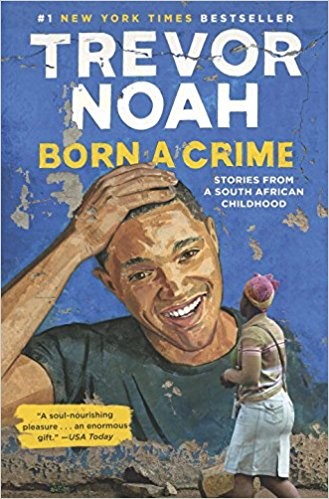
Talk to Born a Crime: Stories from a South African Childhood like its author wrote you back.
Get the ideas that fit your life — not generic summaries.
- Chat with the book
- Audiobook-style main ideas
- Adapts to your life and goals
- Helps you take action
Born a Crime: Stories from a South African Childhood, in detail
Born a Crime is Trevor Noah's memoir about growing up mixed-race in South Africa during the final years of apartheid and its chaotic aftermath. The title is literal: under apartheid law, sex between a Black person and a white person was a criminal act, which made Noah's very existence illegal. His Swiss-German father and Xhosa mother navigated an absurd legal landscape to raise him, and much of the book's early tension comes from the practical strategies they used to hide a child who didn't fit any racial category the state had prepared for.
Noah structures the book as linked stories rather than a chronological autobiography. Each chapter drops into a distinct episode — hiding under a car seat to avoid police checkpoints, navigating the hierarchies of a township school, getting briefly abandoned by his mother after she pushed him from a moving taxi to save his life. The stories range from genuinely funny to quietly devastating, often within the same chapter. What holds them together is Noah's insistence on treating his childhood as material for understanding larger systems — apartheid, poverty, language, religion, racial capitalism — rather than as damage to be processed.
Language runs through the book as a recurring theme. Noah grew up speaking multiple languages, including Zulu, Xhosa, Sotho, Afrikaans, and English, and he argues that language is one of the most powerful tools for either including or excluding people. Switching languages let him move between social groups that wouldn't otherwise have intersected. His mother, Patricia, is the book's moral center: a devout, tough, sometimes terrifying woman who believed access to education and God were the only reliable paths out of poverty, and who took both with a seriousness that bordered on extremism.
Noah is a skilled storyteller, and the book reads quickly. The South African political context is woven in naturally rather than explained in footnotes, which means some nuances may slip past readers unfamiliar with the specific mechanics of apartheid and the post-1994 transition. The chapter on his stepfather's violence against his mother is the book's darkest section and the one that most clearly explains Noah's later public positions on domestic abuse. As a portrait of a particular time and place, the book is unusually vivid. As a memoir of self-making, it is less interested in arriving at wisdom than in describing, honestly and with good humor, what it cost to survive.
The big ideas
- 1.
Noah's mixed-race identity meant he belonged to no racial category under apartheid — he could move between Black, white, and colored communities, but was fully claimed by none of them.
- 2.
Language is a form of belonging. Noah argues that speaking someone's language — even imperfectly — signals that you see them as a full person rather than a category.
- 3.
Apartheid was a system designed to make Black South Africans strangers in their own country. Its bureaucratic logic required absurd daily performances of racial identity from everyone inside it.
