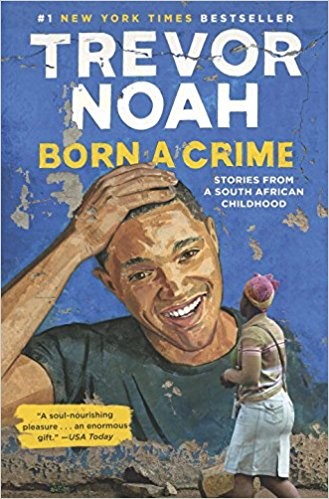
Born a Crime: Stories from a South African Childhood by Trevor Noah is a 2016 memoir book about race and identity, apartheid, survival. Noah's mixed-race identity meant he belonged to no racial category under apartheid — he could move between Black, white, and colored communities, but was fully claimed by none of them.
Summary
Born a Crime is Trevor Noah's memoir about growing up mixed-race in South Africa during the final years of apartheid and its chaotic aftermath. The title is literal: under apartheid law, sex between a Black person and a white person was a criminal act, which made Noah's very existence illegal. His Swiss-German father and Xhosa mother navigated an absurd legal landscape to raise him, and much of the book's early tension comes from the practical strategies they used to hide a child who didn't fit any racial category the state had prepared for.
Noah structures the book as linked stories rather than a chronological autobiography. Each chapter drops into a distinct episode — hiding under a car seat to avoid police checkpoints, navigating the hierarchies of a township school, getting briefly abandoned by his mother after she pushed him from a moving taxi to save his life. The stories range from genuinely funny to quietly devastating, often within the same chapter. What holds them together is Noah's insistence on treating his childhood as material for understanding larger systems — apartheid, poverty, language, religion, racial capitalism — rather than as damage to be processed.
Language runs through the book as a recurring theme. Noah grew up speaking multiple languages, including Zulu, Xhosa, Sotho, Afrikaans, and English, and he argues that language is one of the most powerful tools for either including or excluding people. Switching languages let him move between social groups that wouldn't otherwise have intersected. His mother, Patricia, is the book's moral center: a devout, tough, sometimes terrifying woman who believed access to education and God were the only reliable paths out of poverty, and who took both with a seriousness that bordered on extremism.
Noah is a skilled storyteller, and the book reads quickly. The South African political context is woven in naturally rather than explained in footnotes, which means some nuances may slip past readers unfamiliar with the specific mechanics of apartheid and the post-1994 transition. The chapter on his stepfather's violence against his mother is the book's darkest section and the one that most clearly explains Noah's later public positions on domestic abuse. As a portrait of a particular time and place, the book is unusually vivid. As a memoir of self-making, it is less interested in arriving at wisdom than in describing, honestly and with good humor, what it cost to survive.
Talk to Born a Crime: Stories from a South African Childhood like its author wrote you back.
Get the ideas that fit your life — not generic summaries.
- Chat with the book
- Audiobook-style main ideas
- Adapts to your life and goals
- Helps you take action
Key takeaways
- 1.
Noah's mixed-race identity meant he belonged to no racial category under apartheid — he could move between Black, white, and colored communities, but was fully claimed by none of them.
- 2.
Language is a form of belonging. Noah argues that speaking someone's language — even imperfectly — signals that you see them as a full person rather than a category.
- 3.
Apartheid was a system designed to make Black South Africans strangers in their own country. Its bureaucratic logic required absurd daily performances of racial identity from everyone inside it.
- 4.
Patricia Noah's strategy for her son was education, religion, and mobility — refusing to let poverty or geography determine what was possible. Her ambition was specific and demanding.
- 5.
Poverty creates its own logic. Many of Noah's early hustles and moral compromises make sense only inside a context where the formal economy offers no realistic entry point.
- 6.
Comedy, for Noah, was a survival tool before it was a career. Being able to make people laugh across cultural lines offered protection in environments where his race made him a target.
- 7.
The transition out of apartheid did not end racial hierarchy — it shuffled it. Post-1994 South Africa remained deeply unequal, and the township's internal hierarchies reproduced many of the same patterns the old regime had enforced from outside.
- 8.
Violence against women is treated as ordinary in the world the book describes, until the chapter on Noah's mother and stepfather makes its costs undeniable. Noah connects his mother's survival to her refusal to accept that ordinary as permanent.
Discussion questions
Use these on your own, with a book club, or as chat starters in Superbook. Book club version, ready to copy or print →
- 1.
Noah argues that his inability to fit a racial category gave him a kind of freedom, but also a kind of loneliness. Have you ever been in a position where belonging nowhere allowed you to move everywhere?
- 2.
Language functions as a social passport in the book. What languages — literal or metaphorical — do you code-switch between in your own life, and what does each one cost you?
- 3.
Patricia Noah is presented as both the person who saved her son and someone whose religious intensity made her genuinely difficult to live with. How do you weigh those two readings of her?
- 4.
Noah describes apartheid's bureaucratic machinery with dark humor. What does using humor to describe systemic oppression accomplish — and what might it obscure?
- 5.
The book argues that poverty is not a character flaw but a system of constraints. What specific constraints in Noah's childhood shaped decisions that might look like bad choices from outside?
- 6.
Noah got his first break partly through language skills, partly through luck, and partly through a willingness to hustle in spaces where he had no obvious right to be. How much of that feels like agency, and how much like circumstance?
- 7.
The post-apartheid sections of the book suggest the end of legal racism didn't end structural racism. What examples from the book illustrate that gap most clearly?
- 8.
Noah's relationship with his absent father is handled briefly and without bitterness. Does the restraint in those passages read as wisdom, as unprocessed grief, or something else?
- 9.
The book is dedicated to his mother, and she is clearly its emotional subject. What did Patricia Noah want for her son that she couldn't want for herself?
- 10.
Noah describes the township as a place with its own internal logic, hierarchies, and rules. What assumptions did you bring to reading about it, and which ones got challenged?
- 11.
Many of the book's funniest episodes involve someone being in serious danger. What does it mean to laugh at the same moment you recognize the stakes?
- 12.
If Noah had grown up in a country without apartheid's racial classification system, which parts of his personality — as he describes it — might never have developed?
Themes
Frequently asked questions
-
Is Born a Crime worth reading?
Yes. It is one of the better political memoirs of the last decade, mainly because Noah uses his own story to explain how a system works rather than simply to testify that it hurt him. Readers with no prior knowledge of South African history will come away understanding apartheid better than most summaries provide.
-
How long does it take to read Born a Crime?
Around five hours at average reading pace for the 288-page book. The chapters are self-contained stories, which makes it easy to read in short sessions. The audiobook, narrated by Noah and widely considered the better format, runs about eight hours.
-
What is Born a Crime actually about?
It is about growing up mixed-race in South Africa during the collapse of apartheid and the messy decade that followed. The central relationship is between Noah and his mother, Patricia. The political history is present throughout but delivered through personal anecdotes rather than exposition.
-
Who should read Born a Crime?
Anyone interested in how systems of racial classification shape individual lives, or in memoirs that use humor to address serious history. It works equally well as a coming-of-age story and as an accessible entry point to South African history for readers who have no background in it.
-
What's the most memorable passage in Born a Crime?
The chapter describing Patricia Noah's shooting — and her survival — is the book's emotional climax. It reframes everything that came before it and explains, more than any other section, why Noah writes about his mother the way he does throughout.