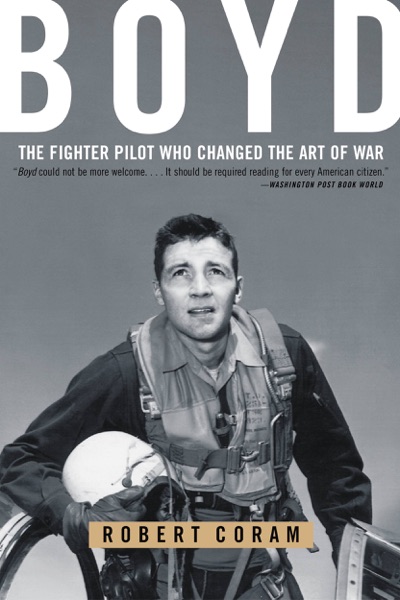
Talk to Boyd: The Fighter Pilot Who Changed the Art of War like its author wrote you back.
Get the ideas that fit your life — not generic summaries.
- Chat with the book
- Audiobook-style main ideas
- Adapts to your life and goals
- Helps you take action
Boyd: The Fighter Pilot Who Changed the Art of War, in detail
Boyd is Robert Coram's biography of Colonel John Boyd, the Air Force fighter pilot who became one of the most influential military strategists of the twentieth century without ever having commanded a major unit, written a best-selling book, or achieved the rank that would have made him famous while alive. Boyd died in 1997 relatively obscure. The people who knew his work — Marine generals, Pentagon reformers, business strategists, software developers — considered him a genius. The people who ran the Air Force spent much of his career trying to neutralize him.
Boyd's first major contribution was technical. His "energy-maneuverability" theory, developed in the late 1950s and early 1960s, gave the Air Force its first quantitative framework for evaluating and comparing fighter aircraft performance. The theory exposed serious flaws in the F-105 and influenced the design of the F-15 and F-16. Boyd developed it against active institutional resistance and without official support, doing the math on government time he was not supposed to be using for personal research.
His more lasting contribution was the OODA loop: Observe, Orient, Decide, Act. Boyd presented the OODA loop first as an account of aerial combat — the pilot who cycles through the loop faster has the initiative — and then generalized it into a theory of competitive decision-making in any domain. The loop is often presented as a simple four-step model, which loses most of Boyd's meaning. His key insight was that the Orient phase is where everything happens: how you process what you observe, the mental models you bring, the assumptions embedded in your training. Faster cycling matters, but faster cycling with bad orientation produces confident errors.
The biographical narrative is as gripping as the intellectual one. Boyd was brilliant, difficult, generous to his acolytes, and contemptuous of careerism. He alienated superiors deliberately, gave away his ideas rather than publishing them, and spent the last decades of his life developing a sprawling briefing called "A Discourse on Winning and Losing" that synthesized his thinking across physics, thermodynamics, military history, and epistemology. Coram's book is the best single source on both the man and his ideas, and it belongs in the reading lists of anyone interested in strategy, organizational design, or the relationship between unconventional thinkers and the institutions they work inside.
The big ideas
- 1.
The OODA loop — Observe, Orient, Decide, Act — is Boyd's model of competitive decision-making. The pilot who cycles faster and with more accurate orientation wins, regardless of absolute speed or strength.
- 2.
Orientation is the most important phase of the OODA loop. How you process observations depends on mental models, cultural traditions, previous experiences, and the implicit assumptions embedded in your training.
- 3.
Getting inside an opponent's OODA loop means acting before they have finished reacting to your last action. This creates confusion, forces errors, and degrades their ability to respond effectively.
