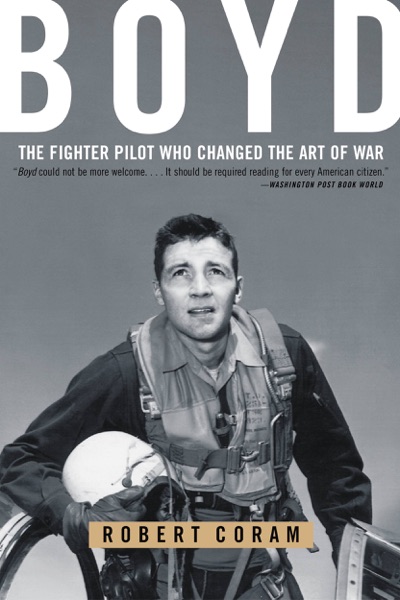
Boyd: The Fighter Pilot Who Changed the Art of War by Robert Coram is a 2002 biography book about military strategy, innovation, decision-making. The OODA loop — Observe, Orient, Decide, Act — is Boyd's model of competitive decision-making. The pilot who cycles faster and with more accurate orientation wins, regardless of absolute speed or strength.
Summary
Boyd is Robert Coram's biography of Colonel John Boyd, the Air Force fighter pilot who became one of the most influential military strategists of the twentieth century without ever having commanded a major unit, written a best-selling book, or achieved the rank that would have made him famous while alive. Boyd died in 1997 relatively obscure. The people who knew his work — Marine generals, Pentagon reformers, business strategists, software developers — considered him a genius. The people who ran the Air Force spent much of his career trying to neutralize him.
Boyd's first major contribution was technical. His "energy-maneuverability" theory, developed in the late 1950s and early 1960s, gave the Air Force its first quantitative framework for evaluating and comparing fighter aircraft performance. The theory exposed serious flaws in the F-105 and influenced the design of the F-15 and F-16. Boyd developed it against active institutional resistance and without official support, doing the math on government time he was not supposed to be using for personal research.
His more lasting contribution was the OODA loop: Observe, Orient, Decide, Act. Boyd presented the OODA loop first as an account of aerial combat — the pilot who cycles through the loop faster has the initiative — and then generalized it into a theory of competitive decision-making in any domain. The loop is often presented as a simple four-step model, which loses most of Boyd's meaning. His key insight was that the Orient phase is where everything happens: how you process what you observe, the mental models you bring, the assumptions embedded in your training. Faster cycling matters, but faster cycling with bad orientation produces confident errors.
The biographical narrative is as gripping as the intellectual one. Boyd was brilliant, difficult, generous to his acolytes, and contemptuous of careerism. He alienated superiors deliberately, gave away his ideas rather than publishing them, and spent the last decades of his life developing a sprawling briefing called "A Discourse on Winning and Losing" that synthesized his thinking across physics, thermodynamics, military history, and epistemology. Coram's book is the best single source on both the man and his ideas, and it belongs in the reading lists of anyone interested in strategy, organizational design, or the relationship between unconventional thinkers and the institutions they work inside.
Talk to Boyd: The Fighter Pilot Who Changed the Art of War like its author wrote you back.
Get the ideas that fit your life — not generic summaries.
- Chat with the book
- Audiobook-style main ideas
- Adapts to your life and goals
- Helps you take action
Key takeaways
- 1.
The OODA loop — Observe, Orient, Decide, Act — is Boyd's model of competitive decision-making. The pilot who cycles faster and with more accurate orientation wins, regardless of absolute speed or strength.
- 2.
Orientation is the most important phase of the OODA loop. How you process observations depends on mental models, cultural traditions, previous experiences, and the implicit assumptions embedded in your training.
- 3.
Getting inside an opponent's OODA loop means acting before they have finished reacting to your last action. This creates confusion, forces errors, and degrades their ability to respond effectively.
- 4.
Energy-maneuverability theory gave the Air Force a quantitative language for aircraft performance tradeoffs. It was also the first time Boyd demonstrated his career-long pattern: developing important work while fighting the institution that needed it.
- 5.
Boyd chose impact over advancement at every career juncture. His ideas influenced the design of the F-15 and F-16, the doctrine of maneuver warfare, and the Gulf War campaign, but he never became a general.
- 6.
Institutional resistance to unconventional thinking is not random. Organizations reward conformity and predictability because those traits reduce coordination costs. The cost is that genuine innovation almost always comes from outside or against the institutional mainstream.
- 7.
Maneuver warfare — the doctrine adopted by the Marine Corps in the 1980s and credited with success in Desert Storm — is largely Boyd's creation, developed in collaboration with a small group of military reformers during the late 1970s and 1980s.
- 8.
Boyd's later theoretical work extended the OODA loop into thermodynamics and epistemology, arguing that all competitive systems must destroy and recreate themselves continually or collapse into entropy. The biological metaphor: evolve or die.
Discussion questions
Use these on your own, with a book club, or as chat starters in Superbook. Book club version, ready to copy or print →
- 1.
Boyd chose to give away his ideas rather than publish them, protecting his ability to think and revise rather than defend a fixed text. What are the trade-offs of that approach to intellectual work?
- 2.
The Air Force spent much of Boyd's career trying to manage him out. What does that institutional pattern tell us about how large organizations relate to unconventional thinkers?
- 3.
The OODA loop is often reduced to a simple cycle. What is lost when it is presented that way, and why do you think people keep oversimplifying it?
- 4.
Boyd's energy-maneuverability theory was developed against official resistance on government time he was not supposed to be using. How do you think about the ethics of that kind of unauthorized work?
- 5.
Boyd's concept of orientation — the mental models that shape how you process what you observe — is the loop's most important element. What does examining your own orientation reveal about your assumptions?
- 6.
Maneuver warfare focuses on disrupting the enemy's decision cycle rather than destroying their forces. How does that principle apply outside of military contexts — in business competition, in organizational design?
- 7.
Coram argues that Boyd traded advancement for impact. Is that trade-off real, or is it a romanticized version of what actually happened to a difficult person?
- 8.
Boyd's briefings ran for fifteen hours. What does that choice — refusing to compress or publish — say about how he thought his ideas should be transmitted?
- 9.
The Gulf War is cited as a validation of Boyd's maneuver warfare doctrine. Does a single historical event validate a strategic theory, or does that create a false sense of certainty?
- 10.
Boyd's personal life was genuinely difficult — he was absent, demanding, and financially irresponsible to his family. How do you hold that alongside the intellectual achievement?
- 11.
Which institutions in your own field most resemble the Air Force bureaucracy Boyd fought — resistant to unconventional thinking, organized to protect the status quo?
- 12.
Boyd never commanded a major unit and never led troops in sustained combat. Does that undermine his authority as a strategist, or is that framing itself part of the institutional thinking he was arguing against?
Themes
Frequently asked questions
-
Do I need a military background to appreciate Boyd?
No. The military context is accessible and Coram explains technical concepts clearly. Boyd's ideas about decision-making, organizational behavior, and institutional resistance translate directly to business, software development, and any field where speed and adaptability matter.
-
What is the OODA loop actually about?
A model of competitive decision-making: Observe (gather information), Orient (process it through your mental models), Decide (select a response), Act (execute). Boyd's key insight is that orientation is the most important phase — faster cycling with bad orientation produces confident errors, not advantage.
-
How long is Boyd?
About 450 pages — an eight-to-nine hour read at average pace. The book is densely researched and the narrative is genuinely propulsive. The technical sections on energy-maneuverability are the only parts that require slow reading.
-
Why isn't Boyd more famous?
He gave away his ideas rather than publishing them, which means there is no canonical text to point to. His briefings circulated informally. He also spent his career in direct conflict with the institutions that would have promoted him, which is not a strategy for fame. His influence is felt through the F-16, Marine Corps doctrine, and a generation of strategists who attended his briefings.
-
What is the book's relevance to business strategy?
The OODA loop has been applied extensively in business contexts, particularly in startup strategy, competitive intelligence, and organizational agility. The core ideas — cycle faster, improve your orientation, disrupt your competitor's ability to respond — transfer clearly. Whether the military context adds or subtracts from the applicability is worth thinking about.