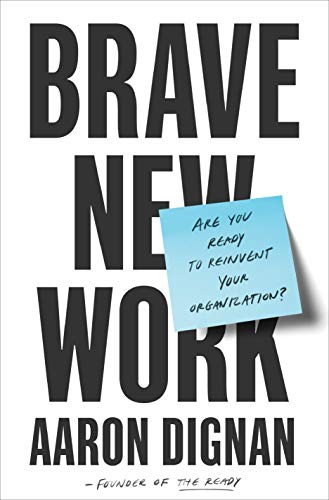
Talk to Brave New Work like its author wrote you back.
Get the ideas that fit your life — not generic summaries.
- Chat with the book
- Audiobook-style main ideas
- Adapts to your life and goals
- Helps you take action
What it argues
Brave New Work is Aaron Dignan's diagnosis of why most organizations are dysfunctional and a practical guide to building something better. Dignan argues that the dominant model of organizational management — hierarchical, process-heavy, compliance-oriented — was designed for a world of routine, predictable work and is dangerously mismatched to the complex, fast-moving environments most organizations now operate in. The result is what he calls the "organizational operating system" (OS) problem: the invisible structures that govern decision-making, compensation, meetings, and planning are the source of most organizational dysfunction, not the people inside them.
The book is organized around twelve domains of organizational life — purpose, authority, structure, strategy, resources, innovation, workflow, meetings, information, membership, mastery, and compensation — and for each domain Dignan describes the conventional approach, its failure modes, and the emerging alternatives being tested by organizations like Buurtzorg, Morning Star, and Patagonia. The unifying thread is distributing authority closer to the work: giving people meaningful autonomy over what they do and how they do it, with coordination happening through protocols and peer accountability rather than hierarchical approval.
What it gets right
- 1.
Every organization runs on an invisible operating system — the assumptions, structures, and practices that determine how decisions get made. Most OS problems are misread as people problems.
- 2.
The command-and-control model was designed for predictable, routine work. Applied to complex, fast-changing environments, it creates the pathologies that make organizations feel slow and frustrating.
- 3.
Distributing authority closer to the work — giving the people doing the work more say over how it gets done — consistently produces better outcomes in complex environments.
What it covers
Who wrote it
Aaron Dignan is the founder of The Ready, an organizational design practice that has worked with companies including American Express, Airbnb, and GitHub to redesign their ways of working. He has spent more than a decade studying and advising organizations navigating complexity, and he is a regular speaker at conferences on the future of work. Brave New Work, published in 2019, synthesizes that practice into a framework that has been widely used by teams and leaders experimenting with self-management and distributed authority.
