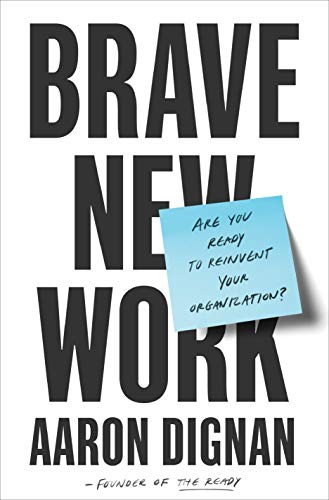
Brave New Work by Aaron Dignan is a 2019 business book about organizational design, self-management, culture change. Every organization runs on an invisible operating system — the assumptions, structures, and practices that determine how decisions get made. Most OS problems are misread as people problems.
Summary
Brave New Work is Aaron Dignan's diagnosis of why most organizations are dysfunctional and a practical guide to building something better. Dignan argues that the dominant model of organizational management — hierarchical, process-heavy, compliance-oriented — was designed for a world of routine, predictable work and is dangerously mismatched to the complex, fast-moving environments most organizations now operate in. The result is what he calls the "organizational operating system" (OS) problem: the invisible structures that govern decision-making, compensation, meetings, and planning are the source of most organizational dysfunction, not the people inside them.
The book is organized around twelve domains of organizational life — purpose, authority, structure, strategy, resources, innovation, workflow, meetings, information, membership, mastery, and compensation — and for each domain Dignan describes the conventional approach, its failure modes, and the emerging alternatives being tested by organizations like Buurtzorg, Morning Star, and Patagonia. The unifying thread is distributing authority closer to the work: giving people meaningful autonomy over what they do and how they do it, with coordination happening through protocols and peer accountability rather than hierarchical approval.
Dignan is careful not to prescribe a single model. The book is not an advertisement for holacracy or any other branded framework. Instead it provides a vocabulary and a lens for examining each domain in your own organization and asking: what is this system actually optimizing for? The answers are often surprising — many organizational processes optimize for comfort, control, or the appearance of accountability rather than the outcomes they claim to pursue.
The book is strongest as a reframing tool. Readers who have felt frustrated by organizational dysfunction but couldn't articulate why will find language here for what they've been experiencing. The prescriptions are less precise — change at this scale requires context that a book can't supply — but Dignan's description of the cultural experiments being run by progressive organizations gives enough texture to see what the alternatives actually look like in practice.
Talk to Brave New Work like its author wrote you back.
Get the ideas that fit your life — not generic summaries.
- Chat with the book
- Audiobook-style main ideas
- Adapts to your life and goals
- Helps you take action
Key takeaways
- 1.
Every organization runs on an invisible operating system — the assumptions, structures, and practices that determine how decisions get made. Most OS problems are misread as people problems.
- 2.
The command-and-control model was designed for predictable, routine work. Applied to complex, fast-changing environments, it creates the pathologies that make organizations feel slow and frustrating.
- 3.
Distributing authority closer to the work — giving the people doing the work more say over how it gets done — consistently produces better outcomes in complex environments.
- 4.
Bureaucracy is often more about managing anxiety and maintaining the appearance of control than about actual coordination. Identifying which rules serve coordination and which serve comfort is a useful diagnostic.
- 5.
Meeting culture is a reliable indicator of organizational health. Organizations that default to large, frequent, low-stakes meetings are usually operating on a trust deficit.
- 6.
Psychological safety and organizational structure are not separate issues. Structures that concentrate power inhibit the honesty that surfaces problems early.
- 7.
Organizational change that starts with culture and values without changing structures is usually insufficient. Structure shapes behavior more reliably than inspiration.
- 8.
The best organizations Dignan studied share a common trait: they have explicit, legible protocols for how decisions get made, rather than implicit norms that favor those already in power.
Discussion questions
Use these on your own, with a book club, or as chat starters in Superbook. Book club version, ready to copy or print →
- 1.
Dignan argues that most organizational problems are OS problems, not people problems. Can you think of an example from your own experience where the system was the actual cause of the dysfunction?
- 2.
Which of the twelve domains Dignan describes — purpose, authority, meetings, compensation, etc. — is most broken in your current organization? What's the evidence?
- 3.
Dignan makes the case for distributing authority. What would have to be true for that to work well in your organization? What conditions currently work against it?
- 4.
When have you encountered a rule or process at work that seemed to exist more to manage anxiety or maintain appearances than to actually solve a problem?
- 5.
Dignan says meeting culture reveals organizational health. What does your meeting culture reveal about your organization?
- 6.
What would it mean for your team to have more explicit, legible decision-making protocols? What decisions currently get made through implicit social dynamics that would be worth making explicit?
- 7.
The book draws on examples like Buurtzorg and Morning Star. What's your reaction to those examples — inspiring, irrelevant, somewhere in between?
- 8.
Where in your organization is psychological safety lowest? What structural features do you think contribute to that?
- 9.
Dignan argues that structural change matters more than culture change. Do you agree? Where in your experience has that been true or false?
- 10.
What is one convention in your current workplace that you follow but have never examined? What is it actually optimizing for?
- 11.
What would the bravest version of a change to your organizational OS look like? What would get in the way of making it?
- 12.
Dignan deliberately avoids prescribing a specific model. Is that restraint helpful or frustrating? What do you wish the book had been more concrete about?
Themes
Frequently asked questions
-
Is Brave New Work worth reading?
Yes, particularly for leaders, managers, and people in organizational design who want a clear vocabulary for diagnosing and improving how their organization actually functions. The diagnostic framework across twelve domains is the most practically useful part. Readers looking for step-by-step change management guidance will need to supplement it.
-
What is the organizational OS idea in Brave New Work?
Dignan uses the operating system metaphor to describe the invisible rules, structures, and assumptions that shape behavior in organizations — the things that determine how decisions get made, who gets heard, and what gets rewarded. His argument is that most organizational dysfunction comes from an outdated OS, not from individual failure.
-
Does Brave New Work promote holacracy or self-management?
It examines self-managed organizations extensively but doesn't promote any single model. Dignan is deliberately pluralistic — he wants readers to understand the principles behind distributed authority, not copy a specific organizational design. The examples include organizations that have invented their own approaches.
-
Who should read Brave New Work?
Leaders and managers who feel frustrated by organizational dysfunction and want a more rigorous frame for diagnosing it. Also useful for HR professionals, consultants, and anyone responsible for how a team or organization is structured and how it makes decisions.
-
How long does it take to read Brave New Work?
Around four to five hours at average reading pace. The twelve-domain structure makes it easy to read in sections and return to the areas most relevant to your organization's current problems.