Talk to Buffettology like its author wrote you back.
Get the ideas that fit your life — not generic summaries.
- Chat with the book
- Audiobook-style main ideas
- Adapts to your life and goals
- Helps you take action
Buffettology, in detail
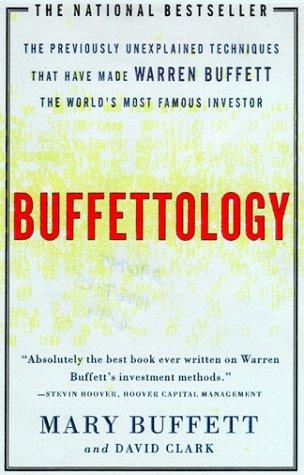
Buffettology is Mary Buffett and David Clark's attempt to systematize Warren Buffett's investment approach by working backward from decisions he made over several decades. Mary Buffett was married to Warren Buffett's son Peter for twelve years and had access to conversations and documents that most outside observers lack. The book's premise is that Buffett's decision-making, while often described as intuitive, follows a consistent and learnable logic that can be made explicit.
The central framework is what Buffett calls a consumer monopoly — a business with a durable competitive advantage that allows it to raise prices without losing customers, requires relatively little capital to maintain, and generates returns on equity that compound reliably over time. Buffett's most celebrated investments (Coca-Cola, See's Candies, American Express) share this structure: strong brands, repeat purchase behavior, pricing power, and low capital intensity. The book works through how to identify these businesses, how to estimate their value, and critically, how to calculate the expected return before buying.
The valuation chapters are the book's most technical and most useful. Buffett's favored tool is the "equity bond" concept: a business with predictable earnings is effectively a bond whose coupon grows over time. The purchase price determines the effective yield, and the long-term return to the investor depends on buying at a price low enough that the compounding of future earnings delivers an acceptable return. The calculations are straightforward and the authors walk through each one with examples drawn from real positions.
The book has limitations. It was written in 1997, and some of the examples now seem dated or oversimplified. The writing occasionally overstates the certainty of judgments that Buffett himself has described as probabilistic and error-prone. But as an accessible account of the economic logic underlying Buffett's approach — why he buys what he buys and holds it for decades — Buffettology remains more useful than most of the Buffett literature that followed it.
The big ideas
- 1.
Consumer monopolies — businesses with durable competitive advantages, pricing power, and low capital requirements — are Buffett's preferred category. He identifies them not by industry but by economic characteristics.
- 2.
The purchase price of any investment determines the long-term return. Buying a great business at too high a price still produces poor results; buying a mediocre business cheaply usually underperforms over time.
- 3.
Predictable earnings allow a business to be modeled like a growing bond. Buffett's equity bond concept ties the expected return directly to the price paid and the projected earnings growth rate.
