Talk to Built to Last: Successful Habits of Visionary Companies like its author wrote you back.
Get the ideas that fit your life — not generic summaries.
- Chat with the book
- Audiobook-style main ideas
- Adapts to your life and goals
- Helps you take action
Built to Last: Successful Habits of Visionary Companies, in detail
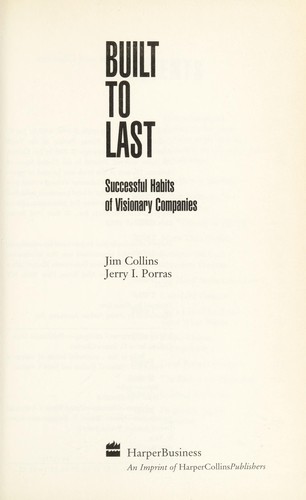
Built to Last is Jim Collins and Jerry Porras's six-year research project into what separates companies that endure for decades from those that simply perform well for a season. Published in 1994, it draws on a study of eighteen "visionary companies" — firms like 3M, Merck, Sony, and Hewlett-Packard — paired with a control group of comparable but less extraordinary competitors. The central finding is counterintuitive: what makes a company last isn't a single great idea, a charismatic founder, or a brilliant strategy. It's a set of organizational practices and cultural commitments that outlive any individual leader or product line.
The book's most useful concept is what Collins and Porras call "the genius of the AND." Most companies treat core values and profit as a tension — you sacrifice one for the other. Visionary companies refuse the trade-off. They preserve a fixed ideological core (a set of values and a sense of purpose) while simultaneously being willing to change everything else: strategies, products, structures, tactics. The Nordstrom family built a retail institution on customer service as an almost religious commitment, and from that fixed core they adapted relentlessly. The values stayed; the methods evolved.
A second major idea is the distinction between a "telling the time" leader and a "building a clock" leader. A charismatic leader who drives results through sheer force of personality tells the time — useful while they're in the room, but the clock stops when they leave. The truly visionary founders built institutions that kept telling time after they were gone. This reframes the common belief that great companies are created by great individuals. Collins and Porras argue the opposite: great individuals who build lasting companies are the ones who made themselves replaceable. Related to this is the concept of Big Hairy Audacious Goals — long-horizon commitments ambitious enough to energize an organization for a decade or more. These weren't stretch targets for the next quarter; they were narrative lodestars that oriented years of effort.
The book has weaknesses worth acknowledging. Several of the eighteen visionary companies it celebrates — Ford, Citicorp, Motorola, Merck — have had serious institutional struggles in the decades since publication. This raises a legitimate question: does the model describe what makes companies last, or does it describe the practices that highly successful companies happen to share at a particular moment in time? Collins addressed some of this in Good to Great, his 2001 follow-up. Built to Last is also research-heavy in a way that rewards patience — the first third lays out methodology before the ideas click into place. For readers who want to understand why some organizations outlast their founders, it remains one of the most rigorous attempts to answer the question.
The big ideas
- 1.
Visionary companies are built on a fixed ideological core — a set of values and a purpose — that never changes, while everything else: strategy, products, structure, is open to evolution.
- 2.
The genius of the AND: lasting companies refuse to choose between ideology and profit, between stability and change. They hold both in tension without sacrificing either.
- 3.
Building a clock beats telling the time. Founders who create lasting institutions make themselves replaceable by building systems and culture, not by being indispensable.
