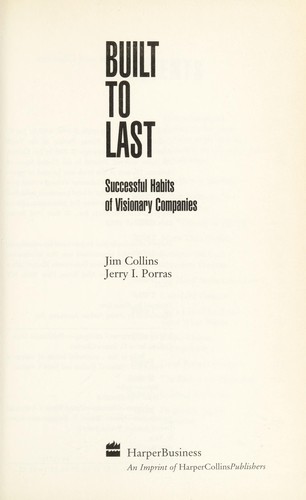
Built to Last: Successful Habits of Visionary Companies by Jim Collins and Jerry I. Porras is a 1994 business book about organizational culture, leadership, long-term thinking. Visionary companies are built on a fixed ideological core — a set of values and a purpose — that never changes, while everything else: strategy, products, structure, is open to evolution.
Summary
Built to Last is Jim Collins and Jerry Porras's six-year research project into what separates companies that endure for decades from those that simply perform well for a season. Published in 1994, it draws on a study of eighteen "visionary companies" — firms like 3M, Merck, Sony, and Hewlett-Packard — paired with a control group of comparable but less extraordinary competitors. The central finding is counterintuitive: what makes a company last isn't a single great idea, a charismatic founder, or a brilliant strategy. It's a set of organizational practices and cultural commitments that outlive any individual leader or product line.
The book's most useful concept is what Collins and Porras call "the genius of the AND." Most companies treat core values and profit as a tension — you sacrifice one for the other. Visionary companies refuse the trade-off. They preserve a fixed ideological core (a set of values and a sense of purpose) while simultaneously being willing to change everything else: strategies, products, structures, tactics. The Nordstrom family built a retail institution on customer service as an almost religious commitment, and from that fixed core they adapted relentlessly. The values stayed; the methods evolved.
A second major idea is the distinction between a "telling the time" leader and a "building a clock" leader. A charismatic leader who drives results through sheer force of personality tells the time — useful while they're in the room, but the clock stops when they leave. The truly visionary founders built institutions that kept telling time after they were gone. This reframes the common belief that great companies are created by great individuals. Collins and Porras argue the opposite: great individuals who build lasting companies are the ones who made themselves replaceable. Related to this is the concept of Big Hairy Audacious Goals — long-horizon commitments ambitious enough to energize an organization for a decade or more. These weren't stretch targets for the next quarter; they were narrative lodestars that oriented years of effort.
The book has weaknesses worth acknowledging. Several of the eighteen visionary companies it celebrates — Ford, Citicorp, Motorola, Merck — have had serious institutional struggles in the decades since publication. This raises a legitimate question: does the model describe what makes companies last, or does it describe the practices that highly successful companies happen to share at a particular moment in time? Collins addressed some of this in Good to Great, his 2001 follow-up. Built to Last is also research-heavy in a way that rewards patience — the first third lays out methodology before the ideas click into place. For readers who want to understand why some organizations outlast their founders, it remains one of the most rigorous attempts to answer the question.
Talk to Built to Last: Successful Habits of Visionary Companies like its author wrote you back.
Get the ideas that fit your life — not generic summaries.
- Chat with the book
- Audiobook-style main ideas
- Adapts to your life and goals
- Helps you take action
Key takeaways
- 1.
Visionary companies are built on a fixed ideological core — a set of values and a purpose — that never changes, while everything else: strategy, products, structure, is open to evolution.
- 2.
The genius of the AND: lasting companies refuse to choose between ideology and profit, between stability and change. They hold both in tension without sacrificing either.
- 3.
Building a clock beats telling the time. Founders who create lasting institutions make themselves replaceable by building systems and culture, not by being indispensable.
- 4.
Big Hairy Audacious Goals (BHAGs) give organizations a decade-scale direction. They work because they're bold enough to be galvanizing, not because they're easily achievable.
- 5.
Cult-like cultures are a feature, not a bug, of enduring companies. Strong values attract people who share them and repel those who don't, which preserves cultural coherence over time.
- 6.
Try a lot of stuff and keep what works. Visionary companies are unusually willing to experiment, and they treat failed experiments as information rather than failure.
- 7.
The most visionary companies have almost always promoted from within. Preserving culture requires that leadership understands the culture from the inside.
- 8.
Comparing yourself to your own best performance, not to the competition, creates a self-driven standard that outlasts any particular competitive landscape.
Discussion questions
Use these on your own, with a book club, or as chat starters in Superbook. Book club version, ready to copy or print →
- 1.
Collins and Porras argue that the most lasting companies have an almost religious commitment to their core values. What distinguishes a genuine core value from a value that's just marketing?
- 2.
Think of an organization you've been part of. What was its actual ideology — what it truly prized above other things — versus the one stated in its mission statement?
- 3.
The book claims charismatic leadership can be a liability for long-term institutional health. Do you find that convincing? Can you name a company where you've seen this dynamic play out?
- 4.
If you were founding a company today, what would go in the fixed core and what would be open to change? How would you decide?
- 5.
BHAGs are meant to be ambitious enough to unify and stretch an organization for years. What makes a goal energizing rather than demoralizing at that scale?
- 6.
Collins and Porras say visionary companies tend to promote from within. What do you lose when you do that consistently, and how do organizations guard against insularity?
- 7.
Several of the book's visionary companies have since declined or faced serious crises. Does that undermine the research findings, or does it simply mean the model describes a period, not a destiny?
- 8.
The book contrasts visionary companies with profit-maximizing ones. Is the framing still useful, or has shareholder-first capitalism changed the conditions under which that contrast holds?
- 9.
The cult-like cultures at companies like Disney, IBM, and HP required a lot of employees to self-select out. What do you think about the trade-offs involved in building that kind of culture?
- 10.
Which concept from the book — the genius of the AND, the BHAG, building a clock, try a lot and keep what works — maps most directly onto something you've observed in an organization you know?
- 11.
Good to Great, Collins's follow-up, studied companies that made the leap from good to great performance. Does that feel like a different question than what Built to Last is asking?
- 12.
The book was published in 1994 and studied companies from an era when stability and longevity were self-evidently good. Does the argument hold in an era of faster disruption?
Themes
Frequently asked questions
-
Is Built to Last still relevant?
Largely yes, with some caveats. The core frameworks — the genius of the AND, BHAGs, building a clock — hold up well as lenses for thinking about organizational design. Some of the specific companies used as examples have since struggled, which is worth knowing as a reader. The research methodology is more rigorous than most business books, which makes the ideas more durable even when individual examples age.
-
How long does it take to read Built to Last?
Roughly seven hours at average reading pace. The book is methodical and research-heavy in the first third; the ideas crystallize more quickly in the second half. Readers who want the frameworks quickly can read the introduction and chapters on the genius of the AND, BHAGs, and clock-building and get most of the model.
-
What is the main difference between Built to Last and Good to Great?
Built to Last asks what makes companies endure across generations. Good to Great asks what triggers exceptional performance in companies that were already good. They're complementary questions: Built to Last is about building institutions; Good to Great is about improving them. Collins positions Good to Great as the prequel — the stage that precedes becoming a visionary company.
-
Who should read Built to Last?
Founders, executives, and anyone thinking seriously about organizational culture and long-term institutional health. It's also valuable for students of business history who want a structured framework for comparing how companies are built, not just how they perform. It's less useful for readers looking for quick tactical advice.
-
What is a Big Hairy Audacious Goal?
A BHAG is a long-horizon goal ambitious enough to orient an organization for ten to thirty years. It's not a mission statement and not a quarterly target — it's something specific enough to know when you've achieved it, bold enough to be galvanizing, and far enough out that reaching it requires sustained organizational commitment, not just a good year.
Similar books
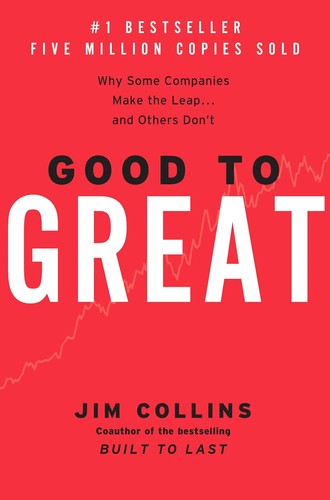
Good to Great
Jim Collins
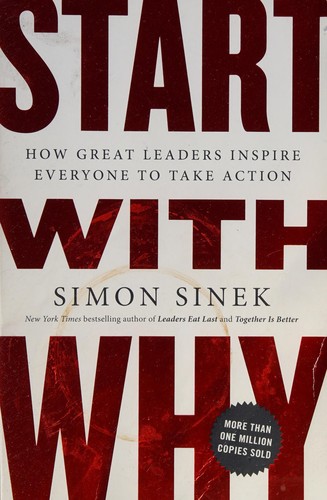
Start with Why
Simon Sinek
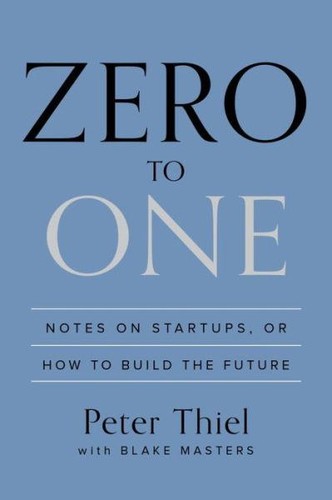
Zero to One: Notes on Startups, or How to Build the Future
Peter Thiel
Drive: The Surprising Truth About What Motivates Us
Daniel H. Pink
Built to Last vs.
Deciding between two books? Built to Last vs Good to Great .
