Talk to Burnout like its author wrote you back.
Get the ideas that fit your life — not generic summaries.
- Chat with the book
- Audiobook-style main ideas
- Adapts to your life and goals
- Helps you take action
Burnout, in detail
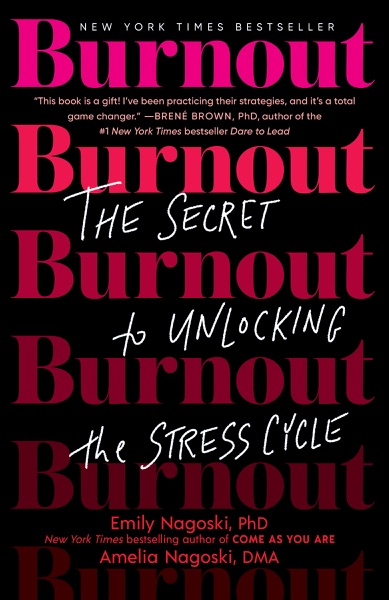
Burnout is Emily and Amelia Nagoski's book about why so many women feel exhausted despite doing everything they're supposed to do — and what to do about it. The central distinction the book builds its argument around is the difference between dealing with stressors and completing the stress response cycle. Most people treat exhaustion as something to push through, or as a problem to solve by removing its causes. The Nagoskis argue this misunderstands the biology: stress is a physiological process, not just a feeling, and the body needs to complete the cycle — through movement, connection, laughter, or some other discharge mechanism — regardless of whether the stressor has been resolved.
This framework comes from stress physiology research. When an animal is chased by a predator and escapes, it shakes, runs, or pants the stress response to completion before resuming normal activity. Humans interrupt this process: we sit with unresolved stress, never completing the loop, and wonder why we feel chronically exhausted. The treatment for burnout, in this view, is not just taking more time off or reducing workload — it's building habits that allow the nervous system to return to baseline, even when the stressors themselves remain.
The second thread of the book is about the particular pressure women face from what the authors call the "Human Giver Syndrome" — the cultural expectation that women should be perpetually giving, pleasant, and self-abnegating. This expectation, they argue, creates a structural unfairness in how stress is distributed: women are not only subject to as many stressors as men but are also expected to absorb and manage the emotional distress of others around them. The book does not pretend this can be fixed by individual behavior change alone, though it focuses on what individuals can do within structures that aren't changing fast enough.
The tone is warm and direct, closer to self-help than clinical writing, with a running sister-dialogue narrative thread that illustrates the concepts in practice. Some readers will find the science presented more confidently than its complexity warrants, and the book's primary audience is clearly women, which limits its applicability as a universal account. But the basic stress physiology framework — separating stressors from stress responses and focusing on completing cycles — is sound and practically useful.
The big ideas
- 1.
The stress response and the stressor are different things. Dealing with the stressor does not complete the physiological stress cycle; the body needs a separate discharge mechanism — exercise, connection, creativity, laughter.
- 2.
Chronic exhaustion comes largely from accumulated incomplete stress cycles, not from the objective quantity of demands on a person's time.
- 3.
Physical movement is the most reliable and well-evidenced way to complete the stress response cycle. Even a twenty-minute walk shifts the physiological baseline.
