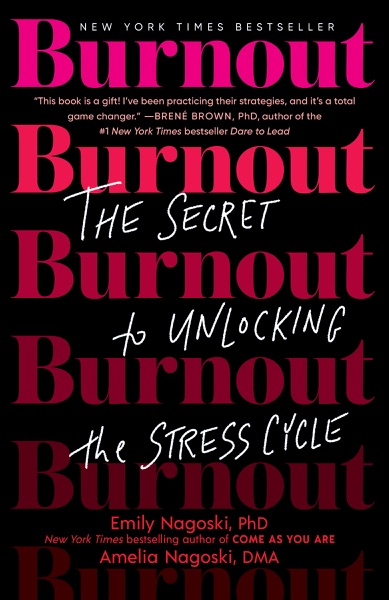
Burnout by Emily Nagoski and Amelia Nagoski is a 2019 health book about stress and recovery, emotional physiology, gender and expectations. The stress response and the stressor are different things. Dealing with the stressor does not complete the physiological stress cycle; the body needs a separate discharge mechanism — exercise, connection, creativity, laughter.
Summary
Burnout is Emily and Amelia Nagoski's book about why so many women feel exhausted despite doing everything they're supposed to do — and what to do about it. The central distinction the book builds its argument around is the difference between dealing with stressors and completing the stress response cycle. Most people treat exhaustion as something to push through, or as a problem to solve by removing its causes. The Nagoskis argue this misunderstands the biology: stress is a physiological process, not just a feeling, and the body needs to complete the cycle — through movement, connection, laughter, or some other discharge mechanism — regardless of whether the stressor has been resolved.
This framework comes from stress physiology research. When an animal is chased by a predator and escapes, it shakes, runs, or pants the stress response to completion before resuming normal activity. Humans interrupt this process: we sit with unresolved stress, never completing the loop, and wonder why we feel chronically exhausted. The treatment for burnout, in this view, is not just taking more time off or reducing workload — it's building habits that allow the nervous system to return to baseline, even when the stressors themselves remain.
The second thread of the book is about the particular pressure women face from what the authors call the "Human Giver Syndrome" — the cultural expectation that women should be perpetually giving, pleasant, and self-abnegating. This expectation, they argue, creates a structural unfairness in how stress is distributed: women are not only subject to as many stressors as men but are also expected to absorb and manage the emotional distress of others around them. The book does not pretend this can be fixed by individual behavior change alone, though it focuses on what individuals can do within structures that aren't changing fast enough.
The tone is warm and direct, closer to self-help than clinical writing, with a running sister-dialogue narrative thread that illustrates the concepts in practice. Some readers will find the science presented more confidently than its complexity warrants, and the book's primary audience is clearly women, which limits its applicability as a universal account. But the basic stress physiology framework — separating stressors from stress responses and focusing on completing cycles — is sound and practically useful.
Talk to Burnout like its author wrote you back.
Get the ideas that fit your life — not generic summaries.
- Chat with the book
- Audiobook-style main ideas
- Adapts to your life and goals
- Helps you take action
Key takeaways
- 1.
The stress response and the stressor are different things. Dealing with the stressor does not complete the physiological stress cycle; the body needs a separate discharge mechanism — exercise, connection, creativity, laughter.
- 2.
Chronic exhaustion comes largely from accumulated incomplete stress cycles, not from the objective quantity of demands on a person's time.
- 3.
Physical movement is the most reliable and well-evidenced way to complete the stress response cycle. Even a twenty-minute walk shifts the physiological baseline.
- 4.
Human Giver Syndrome describes the cultural expectation that women should be perpetually giving, selfless, and emotionally available. This expectation is a structural source of exhaustion that individual habits alone cannot fix.
- 5.
Rest that doesn't feel restful is often rest taken before the stress cycle has been completed. The nervous system has to return to baseline before genuine restoration can occur.
- 6.
Social connection — particularly physical connection like hugging or sustained eye contact — directly completes stress cycles through neurochemical mechanisms.
- 7.
Self-compassion is not a soft concept but a physiological tool: treating yourself with the same care you would offer a friend activates different neural circuits than self-criticism does.
- 8.
Meaning and purpose are stress buffers, not because they make demands smaller but because they provide a frame that makes the demands worth bearing — and that changes their physiological impact.
Discussion questions
Use these on your own, with a book club, or as chat starters in Superbook. Book club version, ready to copy or print →
- 1.
The book's central distinction is between stressors and stress responses. Before reading it, were you treating them as the same thing — and does the distinction change how you think about your own exhaustion?
- 2.
The Nagoskis say most people never complete their stress cycles. What does a completed stress cycle actually feel like, and can you identify times in your life when you've experienced it?
- 3.
Human Giver Syndrome is described as a cultural expectation primarily on women. Do you recognize it in your own life or the lives of people you know — and is it exclusively gendered?
- 4.
The book prescribes physical movement as the most reliable stress-cycle completion tool. Is this realistic for people who are already overwhelmed and time-poor? What would make it more accessible?
- 5.
The authors are sisters, and a narrative thread about their own relationship runs through the book. Does that structure help or hinder the argument?
- 6.
The book is addressed primarily to women. Does that limit its usefulness — and how would a version of this argument directed at men need to be different, if at all?
- 7.
What are the structural, not individual, changes that the Nagoskis imply are necessary? Do they make a sufficient case for those — and what would realistically create them?
- 8.
The idea that rest doesn't work if you take it before completing stress cycles suggests that taking a vacation while still in acute stress may not actually restore you. Does this match your experience?
- 9.
The book presents the science fairly confidently. Are there claims that felt overreached to you — and does it matter if the basic practical advice is sound even if some details are simplified?
- 10.
Social connection as a stress-cycle completion mechanism suggests that isolation amplifies burnout. What does this imply about remote work, loneliness epidemics, and urban design?
- 11.
The book argues that burnout is not a personal failing but a systemic outcome. Does framing it that way change what you think individuals should do about it — or does it feel like an excuse?
- 12.
If you were to implement one recommendation from the book starting tomorrow, what would it be — and what's the most realistic obstacle to it?
Themes
Frequently asked questions
-
What is Burnout about?
It argues that exhaustion comes from incomplete stress cycles, not just too many demands. The authors distinguish between dealing with stressors (the things causing stress) and completing the physiological stress response (what the body needs to return to baseline). The book is focused on women but the core physiology is broadly applicable.
-
Is Burnout scientifically rigorous?
The core stress physiology it draws on is well-supported. Some claims are presented with more confidence than the underlying research warrants, and certain recommendations are more solidly evidenced than others. It reads as accurate popular science rather than a precise academic account — which is appropriate for its genre and audience.
-
What is the most actionable idea in Burnout?
The stress cycle completion framework. Rather than waiting to feel less stressed before trying to relax, the book says you need to actively complete the physiological response — primarily through physical movement. A twenty-minute walk after a difficult workday does something chemically distinct from sitting still.
-
Who should read Burnout?
People who feel chronically exhausted despite having enough time, or who find that rest doesn't actually restore them. It's written primarily for women and addresses the specific cultural pressures women face, but the stress cycle framework is useful for anyone. It's also worth reading for managers, partners, and anyone trying to support someone experiencing burnout.
-
Is Burnout different from standard stress-management books?
Yes, primarily because of the stress cycle distinction. Most stress management focuses on reducing stressors — better time management, saying no, setting limits. This book argues those interventions are necessary but not sufficient: you also need to actively complete the physiological responses that stressors triggered, or exhaustion accumulates regardless.
Similar books
The Upside of Stress
Kelly McGonigal
Why We Sleep
Matthew Walker
Overwhelmed: Work, Love, and Play When No One Has the Time
Brigid Schulte
Rest: Why You Get More Done When You Work Less
Alex Soojung-Kim Pang
