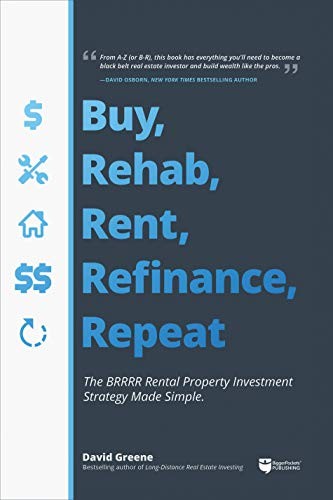
Talk to Buy, Rehab, Rent, Refinance, Repeat like its author wrote you back.
Get the ideas that fit your life — not generic summaries.
- Chat with the book
- Audiobook-style main ideas
- Adapts to your life and goals
- Helps you take action
What it argues
David Greene's book is a deep dive into one specific real estate strategy: BRRRR — Buy a distressed property, Rehab it, Rent it, Refinance to recover your invested capital, and Repeat the cycle. Greene, a former police officer turned full-time investor and co-host of the BiggerPockets podcast, wrote the book to fill a gap he saw in investor education. Most introductory guides tell you that BRRRR exists; this one walks you through how to actually execute it from offer to refinance.
The first part explains why the strategy works. Conventional investing requires a down payment on each property, which limits how many you can buy. BRRRR breaks that constraint by forcing appreciation through rehab, then pulling equity out through a cash-out refinance. Done correctly, you can recover most or all of your initial capital and redeploy it into the next deal while keeping the income-producing property. Greene is honest that "done correctly" requires precision: underestimate the rehab or overestimate the after-repair value and the refinance won't return enough capital to repeat.
What it gets right
- 1.
BRRRR breaks the capital bottleneck of conventional investing. Instead of needing a fresh down payment each time, you recycle equity by refinancing after the rehab and rent-up phase.
- 2.
The after-repair value (ARV) estimate is the single most important number in a BRRRR deal. Every other calculation depends on getting it right.
- 3.
Building a remote team — agent, contractor, property manager — before you buy is not optional. The team is the investment thesis for long-distance BRRRR.
What it covers
Who wrote it
David Greene is a real estate investor, author, and co-host of the BiggerPockets Real Estate Podcast. He worked as a police officer for nearly a decade while building his rental portfolio, eventually leaving law enforcement to invest and write full-time. He has authored several books in the BiggerPockets series, including guides on long-distance real estate investing. Greene is known for his detailed, mechanics-focused approach to investor education and his willingness to share both wins and costly mistakes from his own deals.
