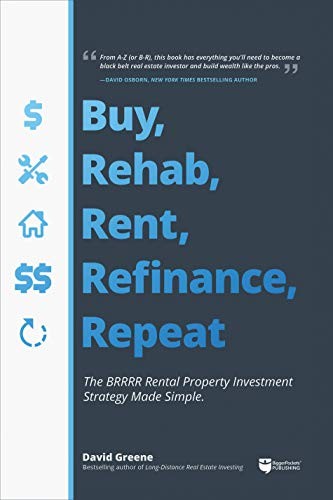
Buy, Rehab, Rent, Refinance, Repeat by David Greene is a 2019 business book about real estate investing, brrrr strategy, wealth building. BRRRR breaks the capital bottleneck of conventional investing. Instead of needing a fresh down payment each time, you recycle equity by refinancing after the rehab and rent-up phase.
Summary
David Greene's book is a deep dive into one specific real estate strategy: BRRRR — Buy a distressed property, Rehab it, Rent it, Refinance to recover your invested capital, and Repeat the cycle. Greene, a former police officer turned full-time investor and co-host of the BiggerPockets podcast, wrote the book to fill a gap he saw in investor education. Most introductory guides tell you that BRRRR exists; this one walks you through how to actually execute it from offer to refinance.
The first part explains why the strategy works. Conventional investing requires a down payment on each property, which limits how many you can buy. BRRRR breaks that constraint by forcing appreciation through rehab, then pulling equity out through a cash-out refinance. Done correctly, you can recover most or all of your initial capital and redeploy it into the next deal while keeping the income-producing property. Greene is honest that "done correctly" requires precision: underestimate the rehab or overestimate the after-repair value and the refinance won't return enough capital to repeat.
The middle chapters are the most detailed. Greene explains how to find distressed properties (off-market outreach, wholesaler relationships, driving for dollars), how to build a reliable rehab team when you don't live near the property, and how to analyze a deal before making an offer. He introduces a scoring system for evaluating markets remotely — a practical framework for long-distance investors who can't just drive the neighborhood.
The back half covers the financing mechanics, including how to structure the refinance with lenders, how seasoning periods work, and how to handle the transition from hard money to conventional financing. Greene also addresses property management at scale, which matters once you're recycling capital quickly. The book is dense in the best sense — not padded — and rewards careful reading alongside actual deal analysis.
Talk to Buy, Rehab, Rent, Refinance, Repeat like its author wrote you back.
Get the ideas that fit your life — not generic summaries.
- Chat with the book
- Audiobook-style main ideas
- Adapts to your life and goals
- Helps you take action
Key takeaways
- 1.
BRRRR breaks the capital bottleneck of conventional investing. Instead of needing a fresh down payment each time, you recycle equity by refinancing after the rehab and rent-up phase.
- 2.
The after-repair value (ARV) estimate is the single most important number in a BRRRR deal. Every other calculation depends on getting it right.
- 3.
Building a remote team — agent, contractor, property manager — before you buy is not optional. The team is the investment thesis for long-distance BRRRR.
- 4.
Lender seasoning periods matter. Most banks won't refinance at appraised value until you've held the property for six to twelve months. Build that into your projections.
- 5.
The quality of your tenant determines cash flow outcomes more than the property itself. Systems for screening and placing tenants are as important as systems for buying deals.
- 6.
Hard money lenders fund acquisitions and rehabs quickly but at high cost. They're a bridge, not a long-term strategy. The refinance into conventional financing closes the loop.
- 7.
Long-distance investing requires trusting your team's judgment, not micromanaging from afar. Hire people whose incentives align with yours.
- 8.
Rehab cost estimation is a skill, not a formula. Until you've managed multiple projects, use conservative buffers and verify contractor bids against third-party data.
Discussion questions
Use these on your own, with a book club, or as chat starters in Superbook. Book club version, ready to copy or print →
- 1.
Greene argues that BRRRR allows infinite scalability. What limits actually constrain how fast someone could grow a portfolio this way?
- 2.
The strategy depends on lender willingness to refinance at appraised value. How would rising interest rates or tighter lending standards change the math?
- 3.
Greene emphasizes building a team before buying. How would you identify and vet a reliable contractor in a market where you have no existing relationships?
- 4.
Long-distance investing removes the ability to check on your investment in person. How comfortable are you with that tradeoff, and how would you manage it?
- 5.
What's the difference between a cosmetic rehab and a structural one, and why does that distinction matter for BRRRR underwriting?
- 6.
Greene says ARV estimation is the most important skill. How would you build that skill before you've bought your first property?
- 7.
If the refinance comes in below your projected ARV, what are your options? How does each one affect your ability to repeat the cycle?
- 8.
Hard money lending is expensive. At what point does the cost of fast capital justify the interest rate, and when does it not?
- 9.
The book focuses on residential real estate. Does the BRRRR framework translate to small commercial properties, and what would change?
- 10.
Greene was a police officer before becoming a full-time investor. What does his path suggest about the timeline for scaling a portfolio while working full-time?
- 11.
What's the biggest assumption in the BRRRR model that scares you most?
- 12.
If you had $50,000 to invest today and wanted to apply the BRRRR strategy, where would you start?
Themes
Frequently asked questions
-
Is Buy, Rehab, Rent, Refinance, Repeat suitable for first-time investors?
It's better as a second or third book. Readers unfamiliar with basic real estate concepts may struggle with the pace. Someone who has read an introductory guide and is actively analyzing deals will get more from it. Greene assumes you understand how rentals work and want to know how to scale.
-
How does BRRRR differ from a standard rental property purchase?
A standard purchase requires a new down payment for each property. BRRRR forces appreciation through rehab, then recovers the invested capital via refinancing, letting you redeploy the same money into the next deal. In theory you can grow a large portfolio from a limited starting amount.
-
What is the biggest risk in the BRRRR strategy?
Overestimating the after-repair value. If the property doesn't appraise high enough post-rehab, the refinance won't return enough capital to repeat the cycle. You're left with trapped equity, a hard money loan, and a forced hold. Conservative ARV estimates and multiple comps before buying are the main protection.
-
How long does it take to read this book?
Around five to six hours for the roughly 300-page text. It's denser than most real estate books and rewards reading alongside a spreadsheet where you can plug in the deal formulas as Greene introduces them.
-
Who specifically benefits most from this book?
Investors who have bought one or two properties conventionally and are trying to scale without tying up more capital. Also useful for people interested in long-distance investing who need a framework for building remote teams and analyzing unfamiliar markets.
Similar books
The Book on Rental Property Investing
Brandon Turner
The Millionaire Real Estate Investor
Gary Keller
The Millionaire Next Door
Thomas J. Stanley
The Simple Path to Wealth
JL Collins
