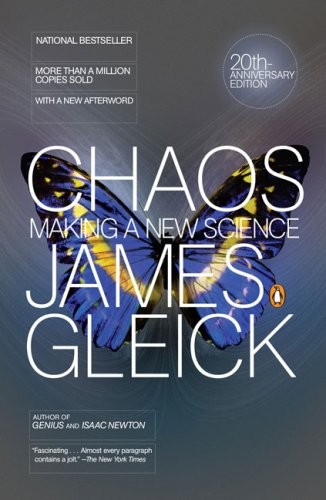
Talk to Chaos: Making a New Science like its author wrote you back.
Get the ideas that fit your life — not generic summaries.
- Chat with the book
- Audiobook-style main ideas
- Adapts to your life and goals
- Helps you take action
What it argues
Chaos: Making a New Science, published in 1987, tells the story of how a loose network of scientists working across meteorology, mathematics, biology, and physics in the 1960s and 1970s developed chaos theory — the study of systems that are deterministic but unpredictable because tiny differences in initial conditions produce wildly different outcomes. Gleick, a science journalist, interviewed most of the principal researchers and reconstructed both the science and the personal dynamics of a field that mainstream physics initially dismissed.
The book opens with Edward Lorenz, a meteorologist at MIT who in 1961 discovered that rounding a number in a weather simulation from 0.506127 to 0.506 — a difference of less than 0.1 percent — produced a completely different weather pattern after a few months. This sensitivity to initial conditions is the defining feature of chaotic systems. Lorenz's further work revealed the "strange attractor" — a fractal geometric object that traces the long-term behavior of chaotic systems — and the so-called butterfly effect, the metaphor that a butterfly flapping its wings in Brazil could set off a tornado in Texas.
What it gets right
- 1.
Chaos theory studies deterministic systems — governed by fixed laws — that are nonetheless unpredictable because small differences in starting conditions grow exponentially over time.
- 2.
The butterfly effect is not just a metaphor: Lorenz's meteorological calculations showed that rounding a number slightly produced entirely different long-term weather patterns.
- 3.
Strange attractors are the geometric shapes that chaotic systems trace over time — complex, fractal structures that look like noise but have underlying order.
What it covers
Who wrote it
James Gleick is an American author and journalist who has written about science for The New York Times and authored several acclaimed books on science and technology. Born in New York in 1954, he co-founded The Pipeline, one of the early internet service providers. His other books include Genius, a biography of Richard Feynman; The Information, a history of information theory; and Faster, about the acceleration of contemporary life. Chaos won the National Book Award finalist designation in 1987 and has sold over a million copies worldwide. Gleick is widely credited with popularizing chaos theory for general audiences.
