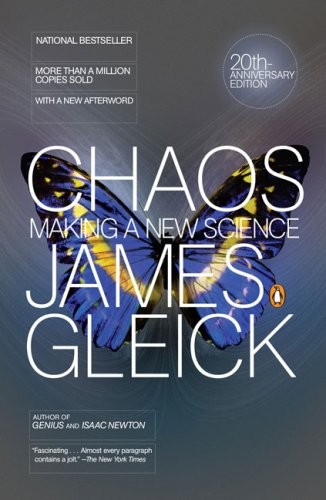
Chaos: Making a New Science by James Gleick is a 1987 science book about chaos theory, complexity, systems. Chaos theory studies deterministic systems — governed by fixed laws — that are nonetheless unpredictable because small differences in starting conditions grow exponentially over time.
Summary
Chaos: Making a New Science, published in 1987, tells the story of how a loose network of scientists working across meteorology, mathematics, biology, and physics in the 1960s and 1970s developed chaos theory — the study of systems that are deterministic but unpredictable because tiny differences in initial conditions produce wildly different outcomes. Gleick, a science journalist, interviewed most of the principal researchers and reconstructed both the science and the personal dynamics of a field that mainstream physics initially dismissed.
The book opens with Edward Lorenz, a meteorologist at MIT who in 1961 discovered that rounding a number in a weather simulation from 0.506127 to 0.506 — a difference of less than 0.1 percent — produced a completely different weather pattern after a few months. This sensitivity to initial conditions is the defining feature of chaotic systems. Lorenz's further work revealed the "strange attractor" — a fractal geometric object that traces the long-term behavior of chaotic systems — and the so-called butterfly effect, the metaphor that a butterfly flapping its wings in Brazil could set off a tornado in Texas.
Gleick follows the development of chaos theory through multiple researchers: Mitchell Feigenbaum, who discovered universal constants governing the transition from orderly to chaotic behavior; Benoit Mandelbrot, who developed fractal geometry to describe the rough, self-similar shapes that chaos produces; Robert May, who found chaotic behavior in simple population models; and many others working on everything from dripping faucets to the turbulence of fluids. The connecting thread is that nature's complexity — the roughness of coastlines, the irregularity of heartbeats, the cascading dynamics of populations — had been idealized away by classical science and was now being taken seriously for the first time.
The book is both a scientific narrative and a sociology of knowledge. Gleick shows how chaos theory struggled for legitimacy, how its practitioners were often outsiders or mavericks, and how the field eventually gained institutional recognition. The writing is vivid and the science is explained without equations, making it accessible to readers with no mathematics background.
Talk to Chaos: Making a New Science like its author wrote you back.
Get the ideas that fit your life — not generic summaries.
- Chat with the book
- Audiobook-style main ideas
- Adapts to your life and goals
- Helps you take action
Key takeaways
- 1.
Chaos theory studies deterministic systems — governed by fixed laws — that are nonetheless unpredictable because small differences in starting conditions grow exponentially over time.
- 2.
The butterfly effect is not just a metaphor: Lorenz's meteorological calculations showed that rounding a number slightly produced entirely different long-term weather patterns.
- 3.
Strange attractors are the geometric shapes that chaotic systems trace over time — complex, fractal structures that look like noise but have underlying order.
- 4.
Fractals — self-similar shapes that look the same at every scale — describe the rough geometry of nature: coastlines, clouds, mountain ranges, and blood vessels.
- 5.
Feigenbaum discovered universal constants governing the period-doubling route from order to chaos, suggesting that different systems become chaotic in the same quantitative way.
- 6.
Classical science dealt with natural complexity by idealizing it away — treating turbulent fluids as smooth, irregular shapes as circles. Chaos theory took the irregularity seriously.
- 7.
Chaos appears in biology: simple equations for population growth exhibit chaotic behavior, which may explain why animal population dynamics are so hard to predict.
- 8.
The chaotic behavior of a dripping faucet — depending on water pressure — demonstrates that everyday systems can exhibit the same fundamental dynamics as weather or turbulence.
Discussion questions
Use these on your own, with a book club, or as chat starters in Superbook. Book club version, ready to copy or print →
- 1.
Lorenz's discovery came from a rounding error in a simulation. What does that accident suggest about how major scientific insights happen?
- 2.
The butterfly effect implies that long-range weather forecasting is theoretically impossible beyond a certain horizon. Does that limit bother you, or does it seem like just a practical constraint?
- 3.
Chaos theory was resisted by mainstream physics for years. Why do established scientific communities resist ideas that later turn out to be important?
- 4.
Fractals describe the rough shapes of nature more accurately than the smooth shapes of Euclidean geometry. Where do you see fractal-like self-similarity in everyday life?
- 5.
Many of the chaos theorists in the book were working across disciplinary boundaries — using physics tools on biology problems, or mathematics on fluid dynamics. What enables that kind of boundary-crossing?
- 6.
The book argues that classical science systematically idealized away the complexity it couldn't handle. What are the costs and benefits of that idealization strategy?
- 7.
Feigenbaum found that different systems — electrical circuits, fluid dynamics, population models — all undergo the same quantitative transition to chaos. What does that universality mean?
- 8.
Gleick suggests chaos theory changed how scientists think about prediction and control. Has it changed how you think about either?
- 9.
The researchers in the book were often mavericks working outside the mainstream. Is nonconformity a cause of scientific innovation or just correlated with it?
- 10.
Chaos is deterministic but unpredictable. Does the distinction between determinism and predictability matter for how you think about free will?
- 11.
The book was written in 1987. How has chaos theory developed since, and has it fulfilled its early promise?
- 12.
What field outside natural science might benefit most from applying chaos theory's insights about sensitive dependence and complex dynamics?
Themes
Frequently asked questions
-
Do I need a math background to read Chaos?
No. Gleick explains all the concepts in plain language and uses no equations. Readers with a mathematics background may find some sections superficial, but the book's strength is narrative and conceptual clarity rather than technical depth.
-
What is the central idea of chaos theory?
That many natural systems are governed by deterministic rules but are nonetheless fundamentally unpredictable because tiny differences in starting conditions grow exponentially. This sensitivity — the butterfly effect — means that long-range prediction is theoretically impossible for these systems regardless of computing power.
-
Is Chaos still accurate?
The historical account is accurate and the core science holds. Some of the applications Gleick suggests have not been as revolutionary as the book implies — chaos theory's impact on medicine and economics turned out to be more limited than early enthusiasts hoped.
-
What is a fractal?
A geometric shape that looks self-similar at different scales — the same kind of roughness or branching pattern repeats whether you zoom in or out. Coastlines, snowflakes, and the branching of blood vessels are all examples. Mandelbrot developed the mathematics of fractals in parallel with chaos theory.
-
Who should read Chaos?
Anyone interested in how scientists think about complex systems, or in the history of how a new scientific field establishes itself. Also useful for people working in fields — finance, ecology, climate — where systems behave in complex, seemingly unpredictable ways.
Similar books

The Information: A History, a Theory, a Flood
James Gleick

The Elegant Universe
Brian Greene
A Short History of Nearly Everything
Bill Bryson

The Second Machine Age
Erik Brynjolfsson and Andrew McAfee
