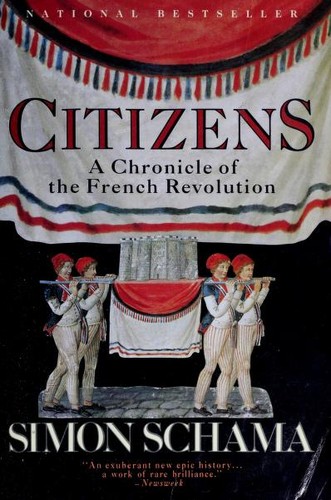
Talk to Citizens: A Chronicle of the French Revolution like its author wrote you back.
Get the ideas that fit your life — not generic summaries.
- Chat with the book
- Audiobook-style main ideas
- Adapts to your life and goals
- Helps you take action
Citizens: A Chronicle of the French Revolution, in detail
Simon Schama's Citizens was published to mark the bicentennial of the French Revolution in 1989 and immediately became one of the most controversial histories of the event in decades. Written against the grain of the dominant Marxist historiography, which interpreted the Revolution as a class struggle that expressed the rising bourgeoisie's conflict with a feudal aristocracy, Schama argues that the Revolution was not inevitable, not progressive in any simple sense, and that the Terror was not an aberration but an expression of tendencies present from the very beginning of the revolutionary impulse.
The book begins before 1789. Schama spends nearly a third of his pages on the last decades of the Ancien Régime, arguing that France in the 1770s and 1780s was actually modernizing — economically dynamic, culturally vibrant, increasingly literate and prosperous. The crisis that produced the Revolution was not a society at the end of its rope but a society in rapid, destabilizing change, whose expectations had outrun its institutions. This reverses the conventional story: what needed reforming was not intolerable stagnation but the failure of reform to keep pace with rising aspirations.
The narrative that follows is rich and novelistic. Schama is interested in the experience of the Revolution as much as its causes — in the pamphlets and festivals and denunciations and tribunals through which ordinary people lived and died under the successive phases of the revolutionary government. He is particularly sharp on the Revolution's relationship with violence: the way violence was aestheticized, ritualized, and converted into civic spectacle by the Jacobins, and the way the logic of the Terror followed from commitments made in the first euphoric months of 1789 rather than from a later corruption.
Citizens is long — over 800 pages — and the density of its narrative history requires patience. It has been criticized for its revisionist thesis, its occasional romanticization of the Ancien Régime, and its relative inattention to social history below the political class. But as a work of historical prose, it is among the finest of its generation, and its central argument — that the Revolution's violence was not an accident but a feature — remains worth arguing with forty years later.
The big ideas
- 1.
The French Revolution was not the inevitable result of intolerable feudal oppression. France in the 1780s was economically dynamic and increasingly prosperous, but its rising expectations had outrun its institutions.
- 2.
The Terror was not an aberration from the Revolution's founding ideals but an expression of tendencies — the embrace of civic violence, the demand for ideological purity, the cult of the general will — present from 1789 itself.
- 3.
The Ancien Régime was more culturally and economically vital than the revolutionary narrative of corrupt decadence allows. Schama's revisionist starting point is that reform was possible and was being attempted.
