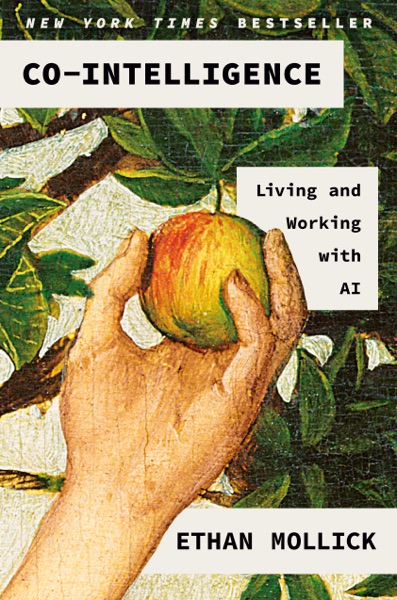
Talk to Co-Intelligence like its author wrote you back.
Get the ideas that fit your life — not generic summaries.
- Chat with the book
- Audiobook-style main ideas
- Adapts to your life and goals
- Helps you take action
What it argues
Co-Intelligence is Ethan Mollick's argument that large language models represent something genuinely new — not a search engine, not a simple automation tool — and that the right response is not fear or hype but active, informed experimentation. Mollick, a Wharton professor who has spent years integrating AI tools into his courses and research, writes from accumulated hands-on experience rather than theoretical prediction.
The book's central framing is the "jagged frontier": AI is not uniformly capable. It performs extraordinarily well on some tasks (drafting, brainstorming, explaining, coding at a certain level) and surprisingly poorly on others (math at a certain complexity, tasks requiring current factual accuracy, anything requiring embodied judgment). Most people don't know where their own tasks fall on that frontier, and most predictions about AI's impact ignore it. Mollick's practical advice is to try things systematically rather than assume.
What it gets right
- 1.
The jagged frontier: AI is unpredictably capable. It excels at some tasks and fails at others in ways that don't follow obvious patterns — you have to test it on your specific work.
- 2.
Treat AI as a collaborator, not a search engine. Giving context, iterating on outputs, and maintaining a conversation produces far better results than single queries.
- 3.
Hallucination is real and persistent. Confident-sounding AI outputs must be verified, especially for facts, citations, and technical claims.
What it covers
Who wrote it
Ethan Mollick is a professor at the Wharton School of the University of Pennsylvania, where he studies and teaches innovation, entrepreneurship, and the future of work. He has been one of the most widely read commentators on the practical implications of large language models, running systematic experiments with AI tools in his courses and writing about the results at his Substack, "One Useful Thing." Co-Intelligence, published in 2024, synthesizes that experimentation into a framework for working alongside AI systems thoughtfully rather than reactively.
