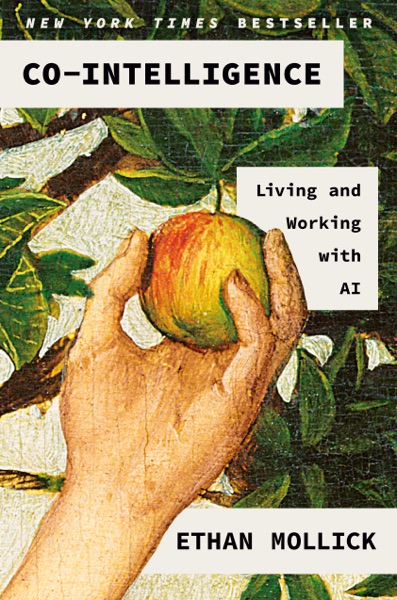
Co-Intelligence by Ethan Mollick is a 2024 business book about artificial intelligence, human-ai collaboration, knowledge work. The jagged frontier: AI is unpredictably capable. It excels at some tasks and fails at others in ways that don't follow obvious patterns — you have to test it on your specific work.
Summary
Co-Intelligence is Ethan Mollick's argument that large language models represent something genuinely new — not a search engine, not a simple automation tool — and that the right response is not fear or hype but active, informed experimentation. Mollick, a Wharton professor who has spent years integrating AI tools into his courses and research, writes from accumulated hands-on experience rather than theoretical prediction.
The book's central framing is the "jagged frontier": AI is not uniformly capable. It performs extraordinarily well on some tasks (drafting, brainstorming, explaining, coding at a certain level) and surprisingly poorly on others (math at a certain complexity, tasks requiring current factual accuracy, anything requiring embodied judgment). Most people don't know where their own tasks fall on that frontier, and most predictions about AI's impact ignore it. Mollick's practical advice is to try things systematically rather than assume.
A large part of the book is about working with AI rather than merely using it. Mollick describes treating the AI as a colleague — a strange one with unlimited patience and no ego — and adjusting your own thinking accordingly. He is candid about the risks: AI systems hallucinate, they can be confidently wrong, and they subtly shape the work they assist with in ways the user may not notice. The solution is not to avoid the tool but to develop critical AI literacy: the ability to evaluate outputs, spot errors, and use the collaboration without offloading judgment entirely.
Mollick is skeptical of both utopian and dystopian framings. He doesn't predict that AI will eliminate most jobs, nor does he dismiss the disruption. His argument is that the people who adapt early and thoughtfully will have a substantial advantage, and that waiting for the technology to stabilize before engaging is itself a costly choice. Co-Intelligence is practical, honest about uncertainty, and considerably more nuanced than most of the AI commentary published around the same time.
Talk to Co-Intelligence like its author wrote you back.
Get the ideas that fit your life — not generic summaries.
- Chat with the book
- Audiobook-style main ideas
- Adapts to your life and goals
- Helps you take action
Key takeaways
- 1.
The jagged frontier: AI is unpredictably capable. It excels at some tasks and fails at others in ways that don't follow obvious patterns — you have to test it on your specific work.
- 2.
Treat AI as a collaborator, not a search engine. Giving context, iterating on outputs, and maintaining a conversation produces far better results than single queries.
- 3.
Hallucination is real and persistent. Confident-sounding AI outputs must be verified, especially for facts, citations, and technical claims.
- 4.
AI shapes the work it helps with. Using it for early drafts anchors your thinking. Being aware of this effect is part of using it well.
- 5.
Early, active experimentation gives a meaningful advantage. Waiting for the technology to mature is a form of falling behind.
- 6.
The most valuable AI skill is judgment about when to trust outputs and when to push back. That skill requires a baseline of domain expertise.
- 7.
AI can function as a 'brilliant friend' who gives genuine expert-level input without the social friction of asking an expert — democratizing access to high-quality advice.
- 8.
The real risk is not that AI will replace human thinking, but that people who rely on it without critical distance will produce confidently mediocre work at scale.
Discussion questions
Use these on your own, with a book club, or as chat starters in Superbook. Book club version, ready to copy or print →
- 1.
Mollick's 'jagged frontier' says AI is uneven in ways that aren't obvious. Which tasks in your own work do you think AI handles better or worse than you'd expect?
- 2.
Have you tried treating an AI as a collaborator — giving it context, pushing back, iterating — rather than just asking it questions? How did the results differ?
- 3.
Mollick says early adopters gain a meaningful advantage. Do you agree, or does that framing create anxiety that oversimplifies the actual shift?
- 4.
Where in your work have you noticed AI shaping your thinking even when you're the one making decisions? Did that feel helpful or limiting?
- 5.
What would it mean to develop 'critical AI literacy' in your field? What errors would you need to be able to spot?
- 6.
The book describes AI as a 'brilliant friend' giving expert-level advice without social friction. What are the limits of that framing?
- 7.
Mollick is candid that AI can be confidently wrong. Has that happened to you? How did you catch it?
- 8.
If AI can produce competent first drafts quickly, what becomes the most valuable thing a skilled human adds to a project?
- 9.
The book avoids both utopian and dystopian predictions. Do you find that balanced, or does it understate the risks?
- 10.
What is a task in your field that you believe AI will never do well? What makes you confident in that judgment?
- 11.
Mollick argues that waiting for the technology to stabilize is itself a costly choice. Is there a point at which that argument becomes a sales pitch for disruption?
- 12.
What would it look like to integrate AI into your work in a way that amplified your judgment rather than replacing it?
Themes
Frequently asked questions
-
What is Co-Intelligence about?
It's Ethan Mollick's practical guide to working with AI tools — large language models in particular — drawn from years of systematic experimentation in his courses at Wharton. The book argues for active engagement over passive skepticism or uncritical adoption.
-
Is Co-Intelligence worth reading in 2026?
Yes. The technology has moved since 2024, but Mollick's frameworks — the jagged frontier, treating AI as a collaborator, maintaining critical distance — are more useful than ever and don't depend on any specific model being current.
-
Who should read Co-Intelligence?
Knowledge workers in any field who want a clear-eyed, practical framework for integrating AI into their work without either overestimating or dismissing it. It's particularly useful for managers, educators, and anyone whose job involves writing, analysis, or advising.
-
What is the jagged frontier?
Mollick's term for AI's uneven capability profile. AI is not uniformly powerful or uniformly limited — it performs surprisingly well on some tasks and surprisingly poorly on others. Knowing where your work falls on that frontier is the most important thing for using AI effectively.
-
What's the most actionable idea in Co-Intelligence?
Run your own experiments. Don't rely on other people's assessments of what AI can and can't do in your field — test it systematically on your actual tasks and build an accurate picture of where it helps and where it misleads.
Similar books
The Second Machine Age
Erik Brynjolfsson and Andrew McAfee
Human Compatible: Artificial Intelligence and the Problem of Control
Stuart Russell

The Alignment Problem
Brian Christian
Deep Work
Cal Newport
