Talk to Competing Against Luck like its author wrote you back.
Get the ideas that fit your life — not generic summaries.
- Chat with the book
- Audiobook-style main ideas
- Adapts to your life and goals
- Helps you take action
What it argues
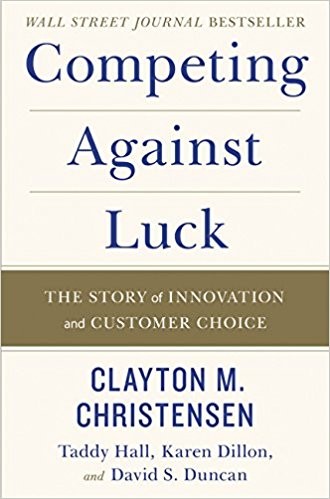
Competing Against Luck is Clayton Christensen's most complete development of the Jobs to Be Done framework, which he introduced briefly in The Innovator's Solution. The core argument is that most companies innovate through a process that resembles luck — adding features, improving specifications, conducting demographic research — rather than through a disciplined understanding of why customers actually buy the things they buy. Jobs to Be Done provides an alternative: customers hire products to accomplish specific jobs in their lives, and understanding the job, not the customer's profile, is what drives reliable innovation.
The jobs framework reframes what a competitor is. A product doesn't just compete with similar products; it competes with anything else the customer might hire to do the same job. Milkshakes compete with bananas and bagels, not just other milkshakes, when the job is to get through a boring morning commute without getting hungry. Understanding the competing hires opens up the design space for improvement in ways that traditional competitive analysis misses entirely.
What it gets right
- 1.
Customers don't buy products — they hire them to accomplish something in their lives. Understanding the job drives more reliable innovation than understanding the customer's demographics or psychographics.
- 2.
Jobs have functional, emotional, and social dimensions. Products that address all three dimensions create stronger loyalty than products that address only the functional task.
- 3.
The competing hire is whoever the customer would use instead if your product didn't exist. It may not be your obvious competitor — it may be a completely different category.
What it covers
Who wrote it
Clayton M. Christensen was a professor at Harvard Business School for more than thirty years until his death in January 2020. He is best known for The Innovator's Dilemma, which introduced the concept of disruptive innovation, and for developing the Jobs to Be Done framework across The Innovator's Solution and Competing Against Luck. He won the McKinsey Award for best Harvard Business Review article five times. Competing Against Luck, published in 2016, was his final major theoretical contribution and represented a decade of developing the Jobs framework with co-authors Taddy Hall, Karen Dillon, and David S. Duncan.
