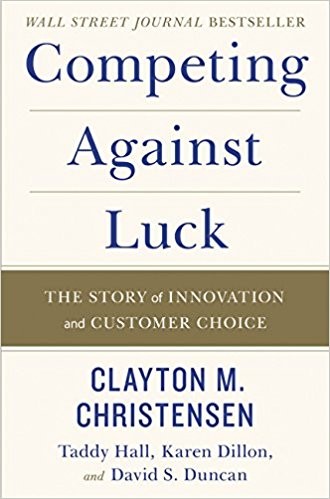
Competing Against Luck by Clayton M. Christensen is a 2016 business book about innovation, marketing, customer discovery. Customers don't buy products — they hire them to accomplish something in their lives. Understanding the job drives more reliable innovation than understanding the customer's demographics or psychographics.
Summary
Competing Against Luck is Clayton Christensen's most complete development of the Jobs to Be Done framework, which he introduced briefly in The Innovator's Solution. The core argument is that most companies innovate through a process that resembles luck — adding features, improving specifications, conducting demographic research — rather than through a disciplined understanding of why customers actually buy the things they buy. Jobs to Be Done provides an alternative: customers hire products to accomplish specific jobs in their lives, and understanding the job, not the customer's profile, is what drives reliable innovation.
The jobs framework reframes what a competitor is. A product doesn't just compete with similar products; it competes with anything else the customer might hire to do the same job. Milkshakes compete with bananas and bagels, not just other milkshakes, when the job is to get through a boring morning commute without getting hungry. Understanding the competing hires opens up the design space for improvement in ways that traditional competitive analysis misses entirely.
Christensen distinguishes between functional, social, and emotional dimensions of every job. A functional job is the practical task; the social job is about how doing it makes you appear to others; the emotional job is about how it makes you feel. Products that address all three dimensions create stronger loyalty than products that address only the functional dimension. This is why some products that are functionally inferior become market leaders — they win on social or emotional dimensions that their functional competitors ignore.
The book also addresses the organizational challenge: building a company that consistently identifies and solves the right jobs requires processes, metrics, and language that most organizations don't have. The Jobs to Be Done framework is not just a product insight — it is an organizational capability that must be deliberately built. The last section on organizational implications is the most challenging to implement and the most commonly skipped.
Talk to Competing Against Luck like its author wrote you back.
Get the ideas that fit your life — not generic summaries.
- Chat with the book
- Audiobook-style main ideas
- Adapts to your life and goals
- Helps you take action
Key takeaways
- 1.
Customers don't buy products — they hire them to accomplish something in their lives. Understanding the job drives more reliable innovation than understanding the customer's demographics or psychographics.
- 2.
Jobs have functional, emotional, and social dimensions. Products that address all three dimensions create stronger loyalty than products that address only the functional task.
- 3.
The competing hire is whoever the customer would use instead if your product didn't exist. It may not be your obvious competitor — it may be a completely different category.
- 4.
Most product failures are not due to bad execution — they are due to solving the wrong job. Companies often build what customers describe wanting rather than what they are actually trying to accomplish.
- 5.
The milkshake insight: customers buying a milkshake in the morning are hiring it for a commute job — something interesting, filling, and easy to consume while driving. Most improvements to milkshakes miss this entirely.
- 6.
Jobs research requires understanding circumstances, not just preferences. Two customers who buy the same product may be hiring it for different jobs based on the circumstances they're in.
- 7.
Big data reveals correlations between customer characteristics and purchases, but it can't reveal causation — it can't tell you why customers make the decisions they make. Jobs interviews fill this gap.
- 8.
Building a Jobs-to-Be-Done capability in an organization requires changing the questions, the research methods, and the language used to describe customers — not just adopting a framework for one product cycle.
Discussion questions
Use these on your own, with a book club, or as chat starters in Superbook. Book club version, ready to copy or print →
- 1.
What job does a product you use regularly actually do for you? Is the product explicitly designed for that job, or did you adapt a product designed for a different job?
- 2.
Christensen says the competing hire is what customers would use if your product didn't exist. What are the real competing hires for a product in your market, and are any of them surprising?
- 3.
The functional-emotional-social job distinction is one of the most useful in the book. Think of a brand loyalty you have: which dimension of the job is driving it?
- 4.
What does Jobs-to-Be-Done research look like in practice? What questions would you ask, and how would you analyze the answers to identify the job versus just the stated preference?
- 5.
Christensen argues most product failures are due to solving the wrong job. What is a product you've seen that was well-executed but failed because it addressed the wrong job?
- 6.
The milkshake example is famous and compelling. What is a product in your industry where similarly non-obvious competing hires or job dimensions would change your product strategy?
- 7.
How does Jobs to Be Done interact with Agile and iterative product development? Can you run short sprints when the goal is to understand the job rather than to ship features quickly?
- 8.
Christensen says big data can't reveal causation — it can't tell you why. What types of research complement big data to provide the causal insight Jobs-to-Be-Done requires?
- 9.
What would it take to build Jobs-to-Be-Done as an organizational capability rather than as a one-time product research technique? What would you need to change?
- 10.
How does the Jobs framework apply to B2B products, where the buyer is often not the end user and the job may be organizational rather than personal?
- 11.
Christensen's theory has both academic and practitioner adherents, but also critics who say it is too vague to be falsifiable. What would make you more or less confident that you've correctly identified a customer's job?
Themes
Frequently asked questions
-
Is Competing Against Luck the best book to start with for Jobs to Be Done?
Yes. It is the most complete treatment of the framework. The Innovator's Solution introduced Jobs briefly; Competing Against Luck develops it fully with research methodology, organizational implications, and a wider range of case studies.
-
What is a 'job' in the Jobs to Be Done framework?
A specific progress a customer is trying to make in a particular circumstance. It has functional dimensions (what they're trying to accomplish), emotional dimensions (how they want to feel), and social dimensions (how they want to be perceived). Understanding all three dimensions reveals what a product needs to be to be reliably hired.
-
How is Jobs to Be Done different from user research?
Traditional user research focuses on what users say they want or like. Jobs research focuses on the circumstances that cause people to hire a product and the progress they're trying to make. The difference is causal: Jobs research explains why, not just what.
-
Does the Jobs framework apply to consumer and B2B equally?
The framework applies to both, but implementation differs. Consumer jobs are often more emotional and social; B2B jobs are often organizational (helping the buyer look good, reducing risk, enabling efficiency). Both require understanding the circumstances that trigger the hire.
-
What is the main criticism of Jobs to Be Done?
The most common criticism is that 'the job' is often defined after the fact to explain a successful product, rather than identified before the fact to predict what will succeed. Christensen addresses this partly in the book, but the framework is easier to apply retrospectively than prospectively.
Similar books
The Innovator's Solution
Clayton M. Christensen and Michael E. Raynor
The Innovator's Dilemma
Clayton M. Christensen
Inspired: How to Create Tech Products Customers Love
Marty Cagan
Continuous Discovery Habits
Teresa Torres
