Talk to Complications like its author wrote you back.
Get the ideas that fit your life — not generic summaries.
- Chat with the book
- Audiobook-style main ideas
- Adapts to your life and goals
- Helps you take action
What it argues
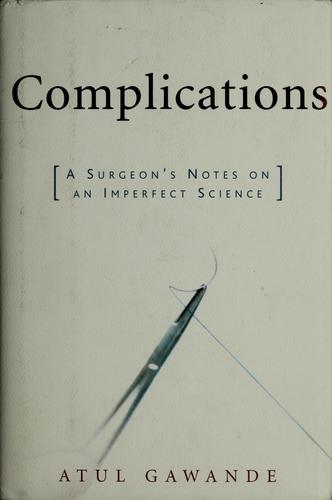
Complications is Atul Gawande's first collection of essays, drawn from his New Yorker writing and his early years as a surgical resident at Brigham and Women's Hospital. The book is divided into three sections — fallibility, mystery, and uncertainty — and each section examines a different dimension of what it is to practice medicine when the knowledge is incomplete, the hands are still learning, and the stakes are measured in lives.
Gawande's central concern is the gap between medicine's image — competent, systematic, evidence-based — and its reality, which is far more contingent. Doctors learn on patients. No amount of simulation substitutes for the first time you do a procedure on a human being, and the system depends on that learning happening without fully disclosing it. The essay on how surgeons acquire technique is among the most honest accounts of medical education available: the first hundred cases of a new surgeon are statistically more likely to go wrong than the next hundred, and someone has to be those first hundred cases.
What it gets right
- 1.
Medicine is learned on patients. Surgical technique, clinical judgment, and diagnostic skill all improve with practice, which means early patients bear a disproportionate share of the learning cost.
- 2.
Error in medicine is not primarily the result of bad or reckless practitioners. It is embedded in the structure of a field where knowledge is incomplete, situations are complex, and pressure is constant.
- 3.
Doctors make diagnostic and treatment decisions using heuristics — pattern-matching shortcuts — that are often effective but fail systematically in predictable ways, the same ways all human cognition fails.
What it covers
Who wrote it
Atul Gawande is an American surgeon, writer, and public health researcher. He is a general and endocrine surgeon at Brigham and Women's Hospital and a professor at Harvard Medical School and the Harvard T.H. Chan School of Public Health. He has been a staff writer at The New Yorker since 1998. His books include Complications, Better, The Checklist Manifesto, and Being Mortal, all of which examine the practice and culture of medicine with unusual clarity. He was awarded a MacArthur Fellowship and has been involved in health policy work including at the World Health Organization.
