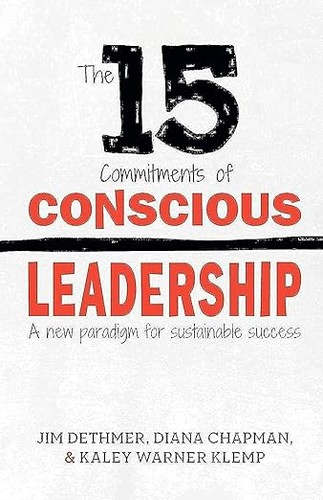
Talk to The 15 Commitments of Conscious Leadership like its author wrote you back.
Get the ideas that fit your life — not generic summaries.
- Chat with the book
- Audiobook-style main ideas
- Adapts to your life and goals
- Helps you take action
The 15 Commitments of Conscious Leadership, in detail
The 15 Commitments of Conscious Leadership is organized around a single distinction: whether a leader is operating from "above the line" (open, curious, committed to learning) or "below the line" (defensive, closed, committed to being right). Dethmer, Chapman, and Klemp — all coaches who work with senior executives — argue that most organizational dysfunction traces back to leaders who are stuck below the line, and that the shift upward requires radical honesty, personal accountability, and a willingness to look at things most leaders prefer to avoid.
The fifteen commitments range from the foundational (taking full responsibility, no longer blaming or complaining) to the more unconventional (speaking your truth, creating a safe space for candor, eliminating gossip entirely). Each chapter presents a commitment as a spectrum: the "to me" victim stance at one end and the "by me" conscious stance at the other. The authors are explicit that the point isn't moral self-improvement but effectiveness — leaders below the line drain energy, create fear, and produce the exact problems they're trying to solve.
Several commitments stand out as genuinely challenging. The chapter on gossip defines it broadly — any talk about a person that you wouldn't say directly to them — and challenges leaders to notice how much of their communication qualifies. The commitment on being in your zone of genius versus zone of excellence is one of the most practically provocative: the idea that staying in work you're very good at but not lit by is its own form of unconscious leadership.
The book is long and the structure is repetitive by design — each chapter uses the same teaching framework. Readers who want practical behavior change will find the early chapters most useful. The later commitments assume a significant degree of prior inner work. The book is probably most effective when read alongside coaching or a team that's genuinely committed to applying the framework rather than just discussing it.
The big ideas
- 1.
The above-the-line/below-the-line distinction is the book's core: conscious leaders remain open and curious, while unconscious leaders close down and defend. Most people spend most of their time below the line.
- 2.
Radical personal responsibility means taking ownership of everything that happens in your life and organization, not as self-blame, but as the recognition that how you respond is always yours.
- 3.
Gossip is defined as any communication about another person that you wouldn't make directly to them. Eliminating it changes organizational culture faster than most other interventions.
