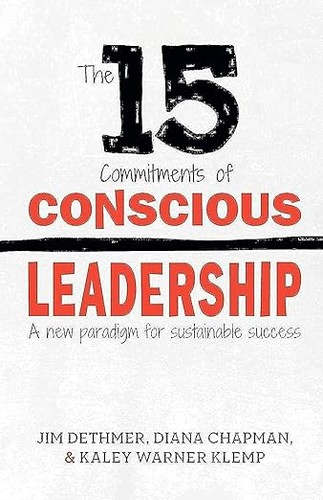
The 15 Commitments of Conscious Leadership by Jim Dethmer, Diana Chapman, and Kaley Klemp is a 2014 business book about conscious leadership, self-awareness, accountability. The above-the-line/below-the-line distinction is the book's core: conscious leaders remain open and curious, while unconscious leaders close down and defend. Most people spend most of their time below the line.
Summary
The 15 Commitments of Conscious Leadership is organized around a single distinction: whether a leader is operating from "above the line" (open, curious, committed to learning) or "below the line" (defensive, closed, committed to being right). Dethmer, Chapman, and Klemp — all coaches who work with senior executives — argue that most organizational dysfunction traces back to leaders who are stuck below the line, and that the shift upward requires radical honesty, personal accountability, and a willingness to look at things most leaders prefer to avoid.
The fifteen commitments range from the foundational (taking full responsibility, no longer blaming or complaining) to the more unconventional (speaking your truth, creating a safe space for candor, eliminating gossip entirely). Each chapter presents a commitment as a spectrum: the "to me" victim stance at one end and the "by me" conscious stance at the other. The authors are explicit that the point isn't moral self-improvement but effectiveness — leaders below the line drain energy, create fear, and produce the exact problems they're trying to solve.
Several commitments stand out as genuinely challenging. The chapter on gossip defines it broadly — any talk about a person that you wouldn't say directly to them — and challenges leaders to notice how much of their communication qualifies. The commitment on being in your zone of genius versus zone of excellence is one of the most practically provocative: the idea that staying in work you're very good at but not lit by is its own form of unconscious leadership.
The book is long and the structure is repetitive by design — each chapter uses the same teaching framework. Readers who want practical behavior change will find the early chapters most useful. The later commitments assume a significant degree of prior inner work. The book is probably most effective when read alongside coaching or a team that's genuinely committed to applying the framework rather than just discussing it.
Talk to The 15 Commitments of Conscious Leadership like its author wrote you back.
Get the ideas that fit your life — not generic summaries.
- Chat with the book
- Audiobook-style main ideas
- Adapts to your life and goals
- Helps you take action
Key takeaways
- 1.
The above-the-line/below-the-line distinction is the book's core: conscious leaders remain open and curious, while unconscious leaders close down and defend. Most people spend most of their time below the line.
- 2.
Radical personal responsibility means taking ownership of everything that happens in your life and organization, not as self-blame, but as the recognition that how you respond is always yours.
- 3.
Gossip is defined as any communication about another person that you wouldn't make directly to them. Eliminating it changes organizational culture faster than most other interventions.
- 4.
The zone of genius concept distinguishes between what you're good at (zone of excellence) and what you're uniquely built for (zone of genius). Staying in excellence at the expense of genius is a common and costly leadership trap.
- 5.
Candor — saying what you actually think to the person who needs to hear it — is a discipline, not a personality trait. Most organizations systematically suppress it.
- 6.
Feelings are data, not obstacles. Leaders who can name what they're feeling without acting it out or suppressing it make better decisions and create more honest cultures.
- 7.
Winning is a trap. The commitment to being right consistently undermines the commitment to being effective. Most arguments in organizations are not about the stated subject.
- 8.
Commitment to creating an environment where truth can be told is more valuable than any single instance of telling the truth.
Discussion questions
Use these on your own, with a book club, or as chat starters in Superbook. Book club version, ready to copy or print →
- 1.
The book says most people spend most of their time below the line. What is your honest estimate of how much of your recent leadership has been below the line?
- 2.
Gossip is defined broadly here — any talk about someone that you wouldn't say directly to them. How much of your daily communication qualifies? What would change if it stopped?
- 3.
Think of a situation where you were committed to being right rather than to learning what was true. What did that cost the outcome?
- 4.
The book distinguishes zone of competence, excellence, and genius. Which zone are you spending most of your time in at work right now?
- 5.
Taking full responsibility doesn't mean taking blame — it means giving up the story that something outside yourself caused the problem. Where are you currently unwilling to do that?
- 6.
The authors say candor is rare because leaders don't create safety for it. What specifically makes candor unsafe in the environment you're part of?
- 7.
Feelings as data: when did a feeling in a meeting signal something important that you didn't acknowledge at the time?
- 8.
Which of the fifteen commitments feels most foreign or most threatening to you — and what does that tell you?
- 9.
The book argues that eliminating drama requires each person to take full responsibility for their own experience. Where is drama currently present in your team, and what's your role in it?
- 10.
Have you experienced a leader who operated consistently above the line? What was it like to work with them compared to leaders who didn't?
- 11.
The zone of genius idea implies that doing what you're merely excellent at is a form of playing small. What would it look like to stop doing that?
- 12.
The commitment to appreciation requires seeing others not for what they produce but for who they are. Is that a natural practice for you or an uncomfortable one?
Themes
Frequently asked questions
-
What is The 15 Commitments of Conscious Leadership about?
The book presents fifteen commitments that shift a leader from reactive, defensive patterns (below the line) to open, curious, accountable leadership (above the line). It draws on executive coaching experience and frames self-awareness as a practical leadership skill, not a personal growth project.
-
Is this book too "woo" for business readers?
Some readers find the language around consciousness and feelings off-putting. The book is written by executive coaches, not behavioral researchers, and its claims aren't heavily empirical. But the frameworks — especially on gossip, candor, and the above/below-the-line distinction — are grounded enough to apply in hard-nosed organizations.
-
How long does it take to read?
About seven to eight hours. The book is over 300 pages and each chapter follows the same structure, which makes it somewhat repetitive. Many readers find it more useful to read one or two chapters and sit with them than to race through all fifteen.
-
Who gets the most from this book?
Leaders who already sense that their own reactions and blind spots are limiting their effectiveness, and who are willing to examine their behavior honestly. It's less useful as a team handbook and more useful as personal development material.
-
What's the single most useful idea?
The above/below-the-line distinction. Once you can recognize in real time whether you're closed and defending or open and curious, you have a choice you didn't have before. Every other commitment builds from that awareness.