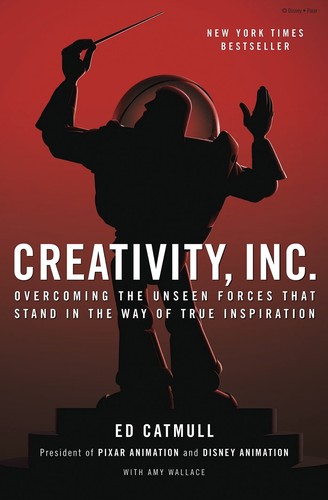
Talk to Creativity, Inc.: Overcoming the Unseen Forces That Stand in the Way of True Inspiration like its author wrote you back.
Get the ideas that fit your life — not generic summaries.
- Chat with the book
- Audiobook-style main ideas
- Adapts to your life and goals
- Helps you take action
Creativity, Inc.: Overcoming the Unseen Forces That Stand in the Way of True Inspiration, in detail
Creativity, Inc. is Ed Catmull's account of building Pixar Animation Studios and the management philosophy that allowed it to produce a string of original films — Toy Story, Finding Nemo, The Incredibles, WALL-E — that were commercially and critically extraordinary by any historical standard. Catmull co-founded Pixar with Steve Jobs and John Lasseter in 1986, ran it for decades, and later served as president of Walt Disney Animation Studios. The book is his attempt to articulate what made Pixar's creative culture work and what threatened it.
The central argument is that creativity cannot be commanded or even reliably predicted, but it can be protected by building the right organizational environment. Catmull's primary tool for this was the Braintrust — a group of trusted directors and writers who reviewed works in progress and gave candid feedback without authority to fix what they criticized. The Braintrust works because it separates diagnosis from prescription: the people who see the problems most clearly are not responsible for solving them, and the person responsible for the film retains the authority to act or not act on the feedback. This combination of candor and autonomy is what most organizations systematically prevent.
Catmull is honest about the ways that well-intentioned management practices create invisible blockages. Fear of embarrassment prevents people from sharing half-formed ideas. Organizational hierarchy filters honest information before it reaches leaders. The appearance of success can mask the accumulation of problems that will eventually surface as crises. He describes what he calls the "ugly baby" problem: every creative project starts as something incomplete and flawed, and organizations that can't protect ugly babies from judgment too early kill ideas before they can develop.
The book covers Pixar's acquisition by Disney in 2006 and Catmull's efforts to apply Pixar's management philosophy to the struggling Disney Animation Studios — a more complex challenge because of the larger organization and different cultural history. Creativity, Inc. is one of the most candid accounts of organizational management written by a practitioner, and it holds up well for anyone trying to build or sustain a culture where people do their best creative work.
The big ideas
- 1.
Creative cultures require specific protection mechanisms because the default organizational dynamics — hierarchy, risk aversion, harmony — systematically suppress the candor that good work requires.
- 2.
The Braintrust separates diagnosis from prescription: trusted peers give candid feedback on works in progress, but the director retains authority to decide how to respond. Candor without authority produces better feedback.
- 3.
Every ambitious creative project starts as an 'ugly baby' — incomplete and flawed. Organizations that expose early work to harsh judgment too soon kill more good ideas than bad ones.
