Creativity, Inc.: Overcoming the Unseen Forces That Stand in the Way of True Inspiration by Ed Catmull and Amy Wallace is a 2014 business book about innovation, organizational culture, creativity. Creative cultures require specific protection mechanisms because the default organizational dynamics — hierarchy, risk aversion, harmony — systematically suppress the candor that good work requires.
Summary
Creativity, Inc. is Ed Catmull's account of building Pixar Animation Studios and the management philosophy that allowed it to produce a string of original films — Toy Story, Finding Nemo, The Incredibles, WALL-E — that were commercially and critically extraordinary by any historical standard. Catmull co-founded Pixar with Steve Jobs and John Lasseter in 1986, ran it for decades, and later served as president of Walt Disney Animation Studios. The book is his attempt to articulate what made Pixar's creative culture work and what threatened it.
The central argument is that creativity cannot be commanded or even reliably predicted, but it can be protected by building the right organizational environment. Catmull's primary tool for this was the Braintrust — a group of trusted directors and writers who reviewed works in progress and gave candid feedback without authority to fix what they criticized. The Braintrust works because it separates diagnosis from prescription: the people who see the problems most clearly are not responsible for solving them, and the person responsible for the film retains the authority to act or not act on the feedback. This combination of candor and autonomy is what most organizations systematically prevent.
Catmull is honest about the ways that well-intentioned management practices create invisible blockages. Fear of embarrassment prevents people from sharing half-formed ideas. Organizational hierarchy filters honest information before it reaches leaders. The appearance of success can mask the accumulation of problems that will eventually surface as crises. He describes what he calls the "ugly baby" problem: every creative project starts as something incomplete and flawed, and organizations that can't protect ugly babies from judgment too early kill ideas before they can develop.
The book covers Pixar's acquisition by Disney in 2006 and Catmull's efforts to apply Pixar's management philosophy to the struggling Disney Animation Studios — a more complex challenge because of the larger organization and different cultural history. Creativity, Inc. is one of the most candid accounts of organizational management written by a practitioner, and it holds up well for anyone trying to build or sustain a culture where people do their best creative work.
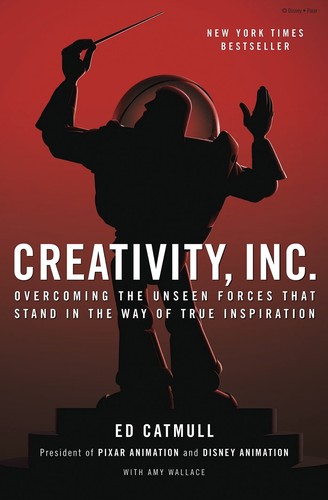
Talk to Creativity, Inc.: Overcoming the Unseen Forces That Stand in the Way of True Inspiration like its author wrote you back.
Get the ideas that fit your life — not generic summaries.
- Chat with the book
- Audiobook-style main ideas
- Adapts to your life and goals
- Helps you take action
Key takeaways
- 1.
Creative cultures require specific protection mechanisms because the default organizational dynamics — hierarchy, risk aversion, harmony — systematically suppress the candor that good work requires.
- 2.
The Braintrust separates diagnosis from prescription: trusted peers give candid feedback on works in progress, but the director retains authority to decide how to respond. Candor without authority produces better feedback.
- 3.
Every ambitious creative project starts as an 'ugly baby' — incomplete and flawed. Organizations that expose early work to harsh judgment too soon kill more good ideas than bad ones.
- 4.
Leaders who communicate only through hierarchy receive filtered information. The people who know what's actually happening are usually not the people in the room.
- 5.
Fear and candor are incompatible. Building an organization where people can say what they think requires explicit and consistent signals from leadership that candor is safe.
- 6.
Postmortems done well are one of the most valuable learning tools. Done poorly — as blame sessions or checkbox exercises — they produce less honesty than silence.
- 7.
Success can hide problems. A string of hits creates complacency and prevents an organization from confronting the issues that will eventually become catastrophic.
- 8.
Pixar's acquisition of Disney Animation showed that the practices that built Pixar didn't automatically transfer. Organizational culture is specific and must be rebuilt, not transplanted.
Discussion questions
Use these on your own, with a book club, or as chat starters in Superbook. Book club version, ready to copy or print →
- 1.
Catmull describes the Braintrust as the single most important management practice at Pixar. What makes it work, and why is this structure so rare in most organizations?
- 2.
The 'ugly baby' problem is that early-stage work needs protection from premature judgment. How do you create that protection in an environment where everyone is busy and opinionated?
- 3.
Catmull says fear and candor are incompatible. What are the specific signals — in meetings, promotions, and how leaders respond to bad news — that communicate whether candor is genuinely safe?
- 4.
What's the difference between an organization that has a diversity of voices and one that has an environment where those voices are actually heard? What creates the gap?
- 5.
Catmull describes postmortems that worked and ones that didn't. What's the difference between a postmortem that produces genuine learning and one that produces only defensive positioning?
- 6.
How do you know when your organization is in the grip of fear? What are the behavioral signs that people are managing appearances rather than doing the work?
- 7.
Catmull argues that success can mask the accumulation of problems. What mechanisms can a leadership team use to see clearly when everything looks fine on the surface?
- 8.
The Braintrust worked because it had both psychological safety and high standards. Can an organization have both, or does one tend to erode the other over time?
- 9.
What did Catmull learn about the limits of transplanting Pixar's culture to Disney Animation? What would you need to change to adapt a creative culture to a different organizational context?
- 10.
Catmull talks about the invisible forces — organizational hierarchy, fear, the appearance of harmony — that suppress creativity. Which one do you think is hardest to see and why?
- 11.
Pixar succeeded by making original films rather than sequels — a financially riskier strategy than what most studios chose. What does that choice tell you about the relationship between creative culture and business model?
- 12.
What's a creative culture outside Pixar that you think manages these challenges well? What practices do they use that are analogous to Catmull's framework?
Themes
Frequently asked questions
-
Is Creativity, Inc. worth reading for people outside creative industries?
Yes. The book is nominally about animation but its core subject is how to build an organization where people do their best work, which is relevant in any industry. The Braintrust model, the problem of candor, and the management of creative risk all transfer.
-
What is the Braintrust at Pixar?
A regular meeting where experienced directors and story people review works in progress and give candid feedback. The key rule: the Braintrust has no authority to tell the director what to do. It can diagnose; it cannot prescribe. This separation keeps feedback honest and preserves the director's creative ownership.
-
How long does Creativity, Inc. take to read?
Around seven hours. The book is narrative and readable, organized around the history of Pixar rather than as a management framework. The management philosophy emerges from the stories rather than being outlined abstractly.
-
What is the ugly baby problem?
Every early-stage creative project — film, product, strategy — is incomplete and flawed. Organizations that allow judgment of early work too soon, before it has had time to develop, kill more good ideas than bad ones. Leaders must protect 'ugly babies' from the people who would kill them for looking ugly.
-
Does Creativity, Inc. discuss Steve Jobs?
Yes, extensively. Jobs was a co-founder of Pixar and Catmull's partner through the company's formative years. Catmull's portrait is nuanced — honest about Jobs's difficult qualities while also crediting his vision, his commitment to making great work, and his loyalty to Pixar when it was struggling.
Similar books
No Rules Rules: Netflix and the Culture of Reinvention
Reed Hastings and Erin Meyer
The Culture Code
Daniel Coyle
The Hard Thing About Hard Things
Ben Horowitz
The Ride of a Lifetime
Robert Iger
