Talk to Crucial Accountability like its author wrote you back.
Get the ideas that fit your life — not generic summaries.
- Chat with the book
- Audiobook-style main ideas
- Adapts to your life and goals
- Helps you take action
What it argues
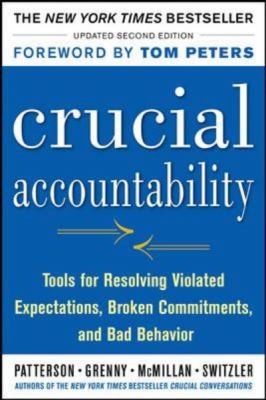
Crucial Accountability is the sequel to Crucial Conversations, narrowing its focus from high-stakes dialogue to one specific problem: what to do when someone fails to meet an expectation. The authors — Kerry Patterson, Joseph Grenny, Ron McMillan, and Al Switzler — argue that most organizations and relationships are weakened not by a lack of accountability intentions but by a lack of accountability skills. People either avoid the conversation entirely or hold it badly, alternating between silence and blow-ups.
The book's structure tracks a conversation from start to finish. Before speaking, diagnose whether you're dealing with a motivation problem (they don't want to do it) or an ability problem (they can't do it). Most managers assume motivation and skip straight to pressure; most of the time the real issue is an ability gap or a missing resource. The right intervention differs completely depending on which you're facing. Getting the diagnosis wrong wastes everyone's time and damages the relationship.
What it gets right
- 1.
Before holding an accountability conversation, diagnose whether you're facing a motivation problem or an ability problem. The intervention differs completely.
- 2.
CPR — Content, Pattern, Relationship — gives you a framework for choosing what to address in the conversation without conflating separate issues.
- 3.
Safety comes first. If the other person feels attacked, they stop listening and the conversation becomes about self-defense rather than the actual problem.
What it covers
Who wrote it
Kerry Patterson, Joseph Grenny, Ron McMillan, and Al Switzler are the co-founders of VitalSmarts, a corporate training company, and the authors of the Crucial Learning series. Their first book, Crucial Conversations, has sold more than five million copies. Together they have consulted for hundreds of organizations and developed training curricula used across corporate, healthcare, and government sectors. Joseph Grenny and Ron McMillan continue to be among the most cited voices in organizational behavior change.
