Crucial Accountability by Kerry Patterson, Joseph Grenny, Ron McMillan, and Al Switzler is a 2013 business book about accountability, difficult conversations, leadership. Before holding an accountability conversation, diagnose whether you're facing a motivation problem or an ability problem. The intervention differs completely.
Summary
Crucial Accountability is the sequel to Crucial Conversations, narrowing its focus from high-stakes dialogue to one specific problem: what to do when someone fails to meet an expectation. The authors — Kerry Patterson, Joseph Grenny, Ron McMillan, and Al Switzler — argue that most organizations and relationships are weakened not by a lack of accountability intentions but by a lack of accountability skills. People either avoid the conversation entirely or hold it badly, alternating between silence and blow-ups.
The book's structure tracks a conversation from start to finish. Before speaking, diagnose whether you're dealing with a motivation problem (they don't want to do it) or an ability problem (they can't do it). Most managers assume motivation and skip straight to pressure; most of the time the real issue is an ability gap or a missing resource. The right intervention differs completely depending on which you're facing. Getting the diagnosis wrong wastes everyone's time and damages the relationship.
When the conversation itself begins, the authors focus on safety first — making the other person feel heard rather than attacked — then on describing the gap between expected and actual behavior without layering in judgment. They introduce tools for "CPR": Content (the specific instance), Pattern (if it's recurring), and Relationship (if the trust is now affected). Different conversations require different CPR levels, and conflating them muddies what's actually at stake.
A running thread is that accountability fails when consequences are either absent or delivered poorly. The book argues that natural consequences, clearly stated, motivate far better than punishments or vague threats. It also addresses motivation: if someone knows what to do and won't do it, understanding the story they're telling themselves is often more productive than escalating pressure. Crucial Accountability is densely practical and slightly repetitive in places, but it fills a real gap in management literature — most advice assumes a single conversation goes well, while this book addresses the messier reality of repeated failures and eroding trust.
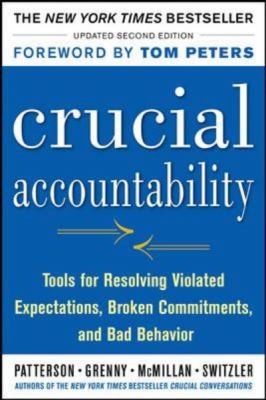
Talk to Crucial Accountability like its author wrote you back.
Get the ideas that fit your life — not generic summaries.
- Chat with the book
- Audiobook-style main ideas
- Adapts to your life and goals
- Helps you take action
Key takeaways
- 1.
Before holding an accountability conversation, diagnose whether you're facing a motivation problem or an ability problem. The intervention differs completely.
- 2.
CPR — Content, Pattern, Relationship — gives you a framework for choosing what to address in the conversation without conflating separate issues.
- 3.
Safety comes first. If the other person feels attacked, they stop listening and the conversation becomes about self-defense rather than the actual problem.
- 4.
Describe the gap between expected and actual behavior in specific, observable terms. Avoid judgment about character or intent.
- 5.
Natural consequences, stated clearly and followed through, motivate far better than vague warnings or punishments after the fact.
- 6.
If someone won't do what they're capable of, understand the story they're telling themselves before escalating. Their reasons may be legitimate or fixable.
- 7.
Accountability conversations that don't result in a clear plan with follow-up dates tend to produce the same failure again. Closing the loop is part of the skill.
- 8.
Avoiding the conversation is its own decision. Silence communicates that the behavior is acceptable, which makes the next breach more likely.
Discussion questions
Use these on your own, with a book club, or as chat starters in Superbook. Book club version, ready to copy or print →
- 1.
Think of an accountability conversation you've been avoiding. What story are you telling yourself about why it will go badly?
- 2.
Patterson's diagnosis: motivation or ability? For the most persistent performance issue in your team, which do you actually think it is?
- 3.
When you last held an accountability conversation poorly, was the failure at safety, diagnosis, describing the gap, or follow-through?
- 4.
The CPR framework separates content from pattern from relationship. Which level do you most often conflate in difficult conversations?
- 5.
What natural consequences exist for the behavior you most need to address, and are you willing to actually let them happen?
- 6.
Have you ever made a commitment to someone and had them not follow up? What did their silence communicate to you about whether the expectation still stood?
- 7.
Think of a manager or leader who held you accountable well. What specifically did they do that made it feel fair rather than punitive?
- 8.
The book argues that most people assume motivation when the real problem is ability or resources. Can you think of an example where that diagnosis error played out?
- 9.
How does your organization's culture affect people's willingness to raise accountability issues upward? What would have to change for that to be safer?
- 10.
When you receive feedback that you haven't met an expectation, what's your first internal reaction — and does it serve you?
- 11.
The book says silence about a breach communicates acceptance. Where in your life are you inadvertently accepting behavior you'd prefer to change?
- 12.
Accountability requires clarity about expectations in the first place. Where are expectations in your team vague enough that accountability conversations are pre-emptively difficult?
Themes
Frequently asked questions
-
Do I need to read Crucial Conversations before Crucial Accountability?
No, but it helps. Crucial Accountability builds on concepts from the first book, especially around safety and storytelling. Readers who start with Accountability sometimes find themselves filling in gaps. Reading them in order takes about eight hours total.
-
What is the difference between Crucial Conversations and Crucial Accountability?
Crucial Conversations covers how to navigate any high-stakes dialogue. Crucial Accountability focuses specifically on the aftermath: what to do when someone has agreed to something and then failed to follow through. The accountability book is narrower and more prescriptive.
-
Is Crucial Accountability useful for non-managers?
Yes. The framework applies to peer relationships, family commitments, and self-accountability, not just manager-employee situations. Anyone who struggles with holding others (or themselves) to expectations without blowing up or going silent will find it useful.
-
How long does it take to read Crucial Accountability?
Around four to five hours for the roughly 270-page book. The writing is clear and example-heavy. Some sections feel repetitive, but each chapter ends with a summary that works well as a review.
-
What is the most actionable idea in Crucial Accountability?
The motivation-versus-ability diagnosis. Most accountability conversations fail because the person holding them assumes the other party is unwilling rather than unable. Asking 'could they do it if their job depended on it?' before the conversation changes how you approach it entirely.
Similar books
Crucial Conversations: Tools for Talking When Stakes Are High
Kerry Patterson, Joseph Grenny, Ron McMillan, and Al Switzler
Difficult Conversations
Douglas Stone, Bruce Patton, and Sheila Heen
Radical Candor
Kim Scott
The Coaching Habit
Michael Bungay Stanier
