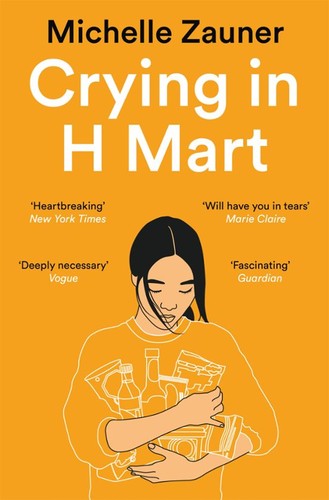
Talk to Crying in H Mart like its author wrote you back.
Get the ideas that fit your life — not generic summaries.
- Chat with the book
- Audiobook-style main ideas
- Adapts to your life and goals
- Helps you take action
Crying in H Mart, in detail
Crying in H Mart is Michelle Zauner's memoir of her mother's death from cancer and the loss it made her confront: not just of a parent but of the Korean half of her identity. Zauner is half-Korean, raised in Eugene, Oregon, by a Korean mother and a white American father. The mother, Chongmi, was the carrier of the culture — Korean food, Korean standards, the Korean language, and a particular form of demanding love. When she died in 2014, Zauner found herself without the primary connection to that inheritance.
The book takes its title from a viral essay Zauner published in The New Yorker in 2018, which described the experience of crying in a Korean grocery store after her mother's death, watching older Korean women who reminded her of what she had lost. The memoir expands that essay into a full portrait of their relationship — which was loving and often bruising — and the period of her mother's illness, during which Zauner moved home to Eugene to care for her and learned to cook Korean food as an act of devotion.
Zauner is a musician — she leads the indie pop band Japanese Breakfast — and her prose has a musician's attention to rhythm and texture. Food is the book's primary language for love, culture, and loss. She writes about specific dishes the way some writers write about books or songs: galbi, doenjang jjigae, japchae, miyeok-guk, the birthday soup her mother made every year. Relearning to cook those dishes after her mother's death is not presented as healing in a clean sense but as a form of preservation — keeping something of the mother alive through the hands.
Crying in H Mart is not primarily a grief memoir in the therapeutic sense. It doesn't resolve, and it doesn't pretend to. Zauner is honest about the difficult dynamics in the relationship — a mother who withheld praise and expressed love most readily through feeding — and equally honest about the way grief clarifies what those withholdings meant. The book ends not with resolution but with the ongoing project of being the person who carries the culture forward, imperfectly, in a body that is only half from there.
The big ideas
- 1.
Food is the book's central metaphor for cultural inheritance: learning to cook Korean food after her mother's death is Zauner's way of preserving a connection to a culture she might otherwise lose entirely.
- 2.
Zauner's biracial identity left her belonging fully in neither American nor Korean contexts — a liminal position her mother navigated for her, and which she had to navigate alone after the death.
- 3.
The mother-daughter relationship was both sustaining and difficult: Chongmi expressed love primarily through care and feeding, and withheld the verbal affirmations Zauner craved.
