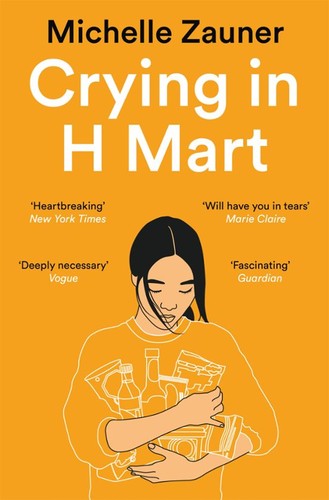
Crying in H Mart by Michelle Zauner is a 2021 memoir book about grief, identity, food and culture. Food is the book's central metaphor for cultural inheritance: learning to cook Korean food after her mother's death is Zauner's way of preserving a connection to a culture she might otherwise lose entirely.
Summary
Crying in H Mart is Michelle Zauner's memoir of her mother's death from cancer and the loss it made her confront: not just of a parent but of the Korean half of her identity. Zauner is half-Korean, raised in Eugene, Oregon, by a Korean mother and a white American father. The mother, Chongmi, was the carrier of the culture — Korean food, Korean standards, the Korean language, and a particular form of demanding love. When she died in 2014, Zauner found herself without the primary connection to that inheritance.
The book takes its title from a viral essay Zauner published in The New Yorker in 2018, which described the experience of crying in a Korean grocery store after her mother's death, watching older Korean women who reminded her of what she had lost. The memoir expands that essay into a full portrait of their relationship — which was loving and often bruising — and the period of her mother's illness, during which Zauner moved home to Eugene to care for her and learned to cook Korean food as an act of devotion.
Zauner is a musician — she leads the indie pop band Japanese Breakfast — and her prose has a musician's attention to rhythm and texture. Food is the book's primary language for love, culture, and loss. She writes about specific dishes the way some writers write about books or songs: galbi, doenjang jjigae, japchae, miyeok-guk, the birthday soup her mother made every year. Relearning to cook those dishes after her mother's death is not presented as healing in a clean sense but as a form of preservation — keeping something of the mother alive through the hands.
Crying in H Mart is not primarily a grief memoir in the therapeutic sense. It doesn't resolve, and it doesn't pretend to. Zauner is honest about the difficult dynamics in the relationship — a mother who withheld praise and expressed love most readily through feeding — and equally honest about the way grief clarifies what those withholdings meant. The book ends not with resolution but with the ongoing project of being the person who carries the culture forward, imperfectly, in a body that is only half from there.
Talk to Crying in H Mart like its author wrote you back.
Get the ideas that fit your life — not generic summaries.
- Chat with the book
- Audiobook-style main ideas
- Adapts to your life and goals
- Helps you take action
Key takeaways
- 1.
Food is the book's central metaphor for cultural inheritance: learning to cook Korean food after her mother's death is Zauner's way of preserving a connection to a culture she might otherwise lose entirely.
- 2.
Zauner's biracial identity left her belonging fully in neither American nor Korean contexts — a liminal position her mother navigated for her, and which she had to navigate alone after the death.
- 3.
The mother-daughter relationship was both sustaining and difficult: Chongmi expressed love primarily through care and feeding, and withheld the verbal affirmations Zauner craved.
- 4.
Grief doesn't follow a timeline. Zauner writes about loss resurfacing years after the death with the same force as in the acute period, triggered by a smell, a dish, an older Korean woman in a grocery store.
- 5.
Caregiving during serious illness is its own form of loss — of the relationship you had before, of the parent's selfhood, of the time and the normalcy that disappear during the illness.
- 6.
Cultural identity requires active maintenance. Zauner's grief is partly about realizing that the work of transmitting Korean culture had been done invisibly by her mother, and that stopping it entirely was a choice she now had to make consciously.
- 7.
Art and creative work — music for Zauner, writing for the memoir — are not presented as escape from grief but as a way of metabolizing it into something that persists.
- 8.
The specific and the universal coexist in the book: the dishes, the Korean words, the particular textures of this relationship are precise and irreplaceable, but the underlying experience of losing a mother and a cultural anchor is widely shared.
Discussion questions
Use these on your own, with a book club, or as chat starters in Superbook. Book club version, ready to copy or print →
- 1.
Zauner's grief is partly about losing access to her Korean identity through her mother. How does cultural inheritance work in your own family — who carries it, and what happens when that person is gone?
- 2.
The book uses food extensively as its emotional language. Is there a food from your own family that functions the same way — as a container for memory, love, or loss?
- 3.
Zauner describes a mother who showed love through action and care rather than words. Have you ever been in or witnessed a relationship where love is expressed that way? What does it feel like from the inside?
- 4.
She moved back home during her mother's illness to become a caregiver. What does caregiving do to the relationship between parent and adult child?
- 5.
The title essay went viral before the book existed. What does it mean for grief to become a publicly shared experience, and does the public response change the private one?
- 6.
Zauner is biracial and describes never fully belonging in either culture. How do you navigate identity when different parts of your background create conflicting expectations?
- 7.
Learning to cook her mother's recipes was Zauner's primary act of mourning. What are the ways you or people you know have tried to hold on to someone through repeating their practices?
- 8.
The book is honest about the parts of the relationship that were difficult — the withholding, the high expectations, the conditional quality of some of the approval. How does grief coexist with that complicated legacy?
- 9.
Zauner describes a particular kind of Korean love as expressed by her mother's side of the family — attentive, food-focused, sometimes harsh. Does the concept of 'love languages' feel adequate to describe that kind of relational dynamic?
- 10.
She eventually channels the experience into both a memoir and an album. Is turning private grief into public art a form of honoring the person, or of using them?
- 11.
The memoir ends without resolution — the grief is ongoing. Is that satisfying as a reader, or do you want narratives of loss to have a more defined arc?
- 12.
What does Crying in H Mart suggest about the role of food in how families pass culture across generations — and what gets lost when that transmission breaks down?
Themes
Frequently asked questions
-
What is Crying in H Mart about?
It's Michelle Zauner's memoir about her mother's death from cancer and the grief, cultural identity, and loss of connection to her Korean heritage that followed. Food — learning to cook her mother's Korean dishes — is the book's central thread.
-
Do you need to know Korean food to appreciate the book?
No. Zauner explains the dishes she describes, but more importantly, food functions as emotional language in the book rather than culinary instruction. Readers who know Korean food will recognize the specifics; those who don't will still understand what the food represents.
-
Is Crying in H Mart a sad book?
Yes, substantially. It's a memoir about a mother dying slowly of cancer, and Zauner doesn't soften the caregiving period or the grief that follows. It is also funny, warm, and precisely written. Most readers find it emotionally demanding and rewarding in roughly equal measure.
-
Who should read Crying in H Mart?
Anyone who has lost a parent or is in the process of losing one, anyone interested in bicultural identity, and anyone who wants an example of grief writing that's honest about difficulty rather than consoling. It works as a companion read to When Breath Becomes Air for similar reasons.
-
Is Michelle Zauner primarily a musician or a writer?
Both, professionally. She built her reputation first as the musician behind Japanese Breakfast, and Crying in H Mart was her debut as a book author. Both the album Jubilee and this memoir were released to major acclaim in 2021. She has spoken about music and writing as different but related modes of processing the same experiences.