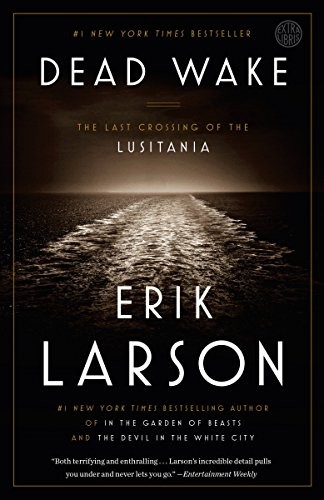
Talk to Dead Wake: The Last Crossing of the Lusitania like its author wrote you back.
Get the ideas that fit your life — not generic summaries.
- Chat with the book
- Audiobook-style main ideas
- Adapts to your life and goals
- Helps you take action
What it argues
Dead Wake tells the story of the sinking of the RMS Lusitania on May 7, 1915, when a German U-boat torpedoed the British ocean liner off the coast of Ireland, killing 1,198 of the 1,959 people aboard, including 128 Americans. The event accelerated American public opinion toward entering the war and is one of the central incidents of World War I's escalation. Erik Larson tells it through three interweaving narratives: the passengers and crew aboard the Lusitania, the U-20 submarine and its commander Walter Schwieger, and Room 40, the British naval intelligence unit that had broken the German naval code and knew where the U-20 was operating.
That third thread — Room 40 — is where Larson's account becomes most unsettling. British naval intelligence possessed information that could have protected the Lusitania by routing it away from the submarine or dispatching a destroyer escort. Neither happened. Larson documents the bureaucratic failures, the turf battles between naval intelligence and operational command, and the possibility — which he addresses carefully — that Churchill or others in the Admiralty may have found a sinking useful for bringing America into the war. He does not accuse Churchill of deliberate conspiracy, but he makes the case that the inaction was remarkable and deserves scrutiny.
What it gets right
- 1.
The Lusitania sank in eighteen minutes after a single torpedo strike, a speed that overwhelmed evacuation procedures and killed most of the 1,198 who died.
- 2.
British naval intelligence (Room 40) had broken the German naval code and knew approximately where the U-20 was operating, yet the Lusitania received no escort and no diversion.
- 3.
The possibility that the Admiralty allowed the sinking to help bring America into the war is not confirmed but not dismissible — the bureaucratic inaction is hard to explain otherwise.
What it covers
Who wrote it
Erik Larson is an American author of narrative nonfiction known for combining exhaustive archival research with the pacing of literary fiction. His other books include The Devil in the White City (2003), Isaac's Storm (1999), The Splendid and the Vile (2020), and The Demon of Unrest (2023). For Dead Wake he drew on passenger diaries, survivor testimony, naval records, Room 40 documents, and the log of U-20's commander. His books regularly appear on bestseller lists and are noted for reconstructing historical events with novelistic precision. He lives in New York City.
