Talk to Dealing with China like its author wrote you back.
Get the ideas that fit your life — not generic summaries.
- Chat with the book
- Audiobook-style main ideas
- Adapts to your life and goals
- Helps you take action
What it argues
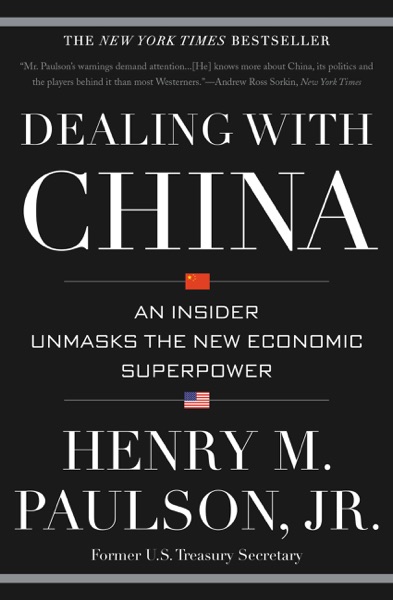
Dealing with China is Henry Paulson's account of thirty years of engagement with China's political and economic leadership, first as head of Goldman Sachs's Asia operations, then as the bank's CEO, and finally as US Treasury Secretary under President George W. Bush. The book is organized around Paulson's direct relationships with Chinese officials — Zhu Rongji, Wang Qishan, Jiang Zemin, Xi Jinping — and the specific transactions and negotiations he participated in or observed over that period. It is not a comprehensive history of US-China relations but a practitioner's report from someone who was in the room.
The core argument Paulson makes is that the transformation of China's economy since the 1990s was the most consequential economic event of his lifetime, and that the key to understanding it is understanding the Chinese state's relationship to economic policy. Unlike Western democracies where economic decisions emerge from distributed political processes, China's leadership could make large-scale strategic commitments and execute them rapidly. This was an advantage in building infrastructure and attracting foreign investment, and a source of fragility in sectors where market signals needed to override central planning.
What it gets right
- 1.
China's economic transformation was driven by a small number of visionary reformers within the party who had to work around deep institutional resistance. Personal relationships with those reformers determined what was possible at any given time.
- 2.
Western financial institutions played a larger role in developing China's capital markets than is generally acknowledged, and the Chinese leadership was more pragmatic about accepting foreign expertise than Western critics assumed.
- 3.
The Chinese state's ability to make rapid large-scale economic commitments was a genuine advantage in the growth phase, but the same concentration of authority that enabled fast action also made course correction difficult.
What it covers
Who wrote it
Henry M. Paulson Jr. served as the 74th United States Secretary of the Treasury from 2006 to 2009, managing the government's response to the 2008 financial crisis including the TARP bank rescue program. Before government service, he spent thirty-two years at Goldman Sachs, serving as its chairman and CEO from 1999 to 2006. He founded the Paulson Institute at the University of Chicago to advance US-China economic engagement and environmental cooperation. Dealing with China was published in 2015 and draws on his unique access to Chinese leadership over three decades.
