Talk to Death by Black Hole like its author wrote you back.
Get the ideas that fit your life — not generic summaries.
- Chat with the book
- Audiobook-style main ideas
- Adapts to your life and goals
- Helps you take action
What it argues
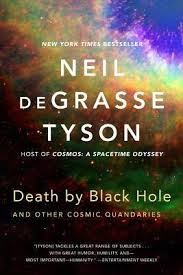
Death by Black Hole is a collection of essays by Neil deGrasse Tyson drawn from his "Universe" column in Natural History magazine. The forty-two essays are organized into seven sections covering the nature of the cosmos, scientific tools and methods, scientific blunders, the laws of physics, the dark side of the universe, science literacy, and the intersection of science and culture. The collection is more varied and personal in tone than Tyson's more focused books, reflecting the essay format's capacity for digression and wit.
The title essay is a highlight: a detailed, viscerally descriptive account of what would actually happen to a human body approaching a stellar-mass black hole, beginning with gravitational tidal forces that stretch the body from feet to head (spaghettification), moving through radiation fluxes and time dilation, and ending with an honest assessment of which cause of death arrives first. The analysis combines rigorous physics with Tyson's gift for making abstract phenomena concrete and slightly absurd.
What it gets right
- 1.
A body falling into a stellar-mass black hole would be spaghettified — stretched vertically and compressed horizontally — by tidal forces long before crossing the event horizon.
- 2.
Stars don't actually twinkle: the scintillation effect is produced by atmospheric turbulence refracting starlight, which is why stars twinkle but planets, which are extended sources, generally don't.
- 3.
Scientific literacy is not just knowing scientific facts but understanding how scientific reasoning works — how hypotheses are tested, how evidence is weighed, and why consensus forms.
What it covers
Who wrote it
Neil deGrasse Tyson is an American astrophysicist and director of the Hayden Planetarium at the American Museum of Natural History. He is one of the most widely recognized science communicators in the United States, known for the StarTalk podcast, the television series Cosmos: A Spacetime Odyssey, and numerous books. He received his doctorate from Columbia University. His monthly column in Natural History magazine, which formed the basis of Death by Black Hole, ran from 1995 to 2005.
