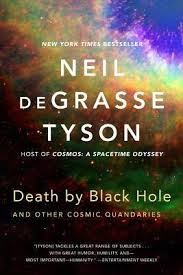
Death by Black Hole by Neil deGrasse Tyson is a 2007 science book about astrophysics, astronomy, scientific thinking. A body falling into a stellar-mass black hole would be spaghettified — stretched vertically and compressed horizontally — by tidal forces long before crossing the event horizon.
Summary
Death by Black Hole is a collection of essays by Neil deGrasse Tyson drawn from his "Universe" column in Natural History magazine. The forty-two essays are organized into seven sections covering the nature of the cosmos, scientific tools and methods, scientific blunders, the laws of physics, the dark side of the universe, science literacy, and the intersection of science and culture. The collection is more varied and personal in tone than Tyson's more focused books, reflecting the essay format's capacity for digression and wit.
The title essay is a highlight: a detailed, viscerally descriptive account of what would actually happen to a human body approaching a stellar-mass black hole, beginning with gravitational tidal forces that stretch the body from feet to head (spaghettification), moving through radiation fluxes and time dilation, and ending with an honest assessment of which cause of death arrives first. The analysis combines rigorous physics with Tyson's gift for making abstract phenomena concrete and slightly absurd.
The science literacy essays are among the most substantive. Tyson argues that a scientifically illiterate population is poorly equipped to evaluate policy claims, susceptible to pseudoscience, and likely to make bad collective decisions about energy, medicine, and technology. He critiques not just popular misconceptions — the idea that we use only 10% of our brains, the notion that stars twinkle — but also the tendency of scientists to communicate badly and the tendency of schools to teach facts rather than the scientific method.
The book is not a systematic account of any single topic. It is best read as a collection of vignettes from a scientist who finds the universe endlessly surprising, and who is as likely to write about the astrophysics of Star Wars as about the nature of dark matter. The voice is entertaining, sometimes didactic, and occasionally edgy.
Talk to Death by Black Hole like its author wrote you back.
Get the ideas that fit your life — not generic summaries.
- Chat with the book
- Audiobook-style main ideas
- Adapts to your life and goals
- Helps you take action
Key takeaways
- 1.
A body falling into a stellar-mass black hole would be spaghettified — stretched vertically and compressed horizontally — by tidal forces long before crossing the event horizon.
- 2.
Stars don't actually twinkle: the scintillation effect is produced by atmospheric turbulence refracting starlight, which is why stars twinkle but planets, which are extended sources, generally don't.
- 3.
Scientific literacy is not just knowing scientific facts but understanding how scientific reasoning works — how hypotheses are tested, how evidence is weighed, and why consensus forms.
- 4.
The history of astronomy is a story of progressively greater cosmic displacement: Earth is not the center of the solar system, the sun is not the center of the galaxy, the Milky Way is not the center of anything.
- 5.
Pseudoscience thrives when people lack the reasoning tools to distinguish it from science, not because they lack intelligence. The goal of science education should be those reasoning tools, not memorized facts.
- 6.
The elements in a human body — carbon, oxygen, nitrogen, iron — all trace back to stellar nucleosynthesis, which makes the connection between astrophysics and biology direct and physical.
- 7.
The cosmic microwave background is observable everywhere in the universe; every time you tune a television between channels, some fraction of the static is radiation from the Big Bang.
- 8.
Scientific errors — wrong models, failed experiments — are not embarrassments but essential parts of the process; the history of science is the history of productive mistakes.
Discussion questions
Use these on your own, with a book club, or as chat starters in Superbook. Book club version, ready to copy or print →
- 1.
Tyson argues that scientific literacy is a civic necessity. What would genuinely scientifically literate civic decision-making look like in practice?
- 2.
The death-by-black-hole essay treats a ghastly scenario with scientific precision and dark humor. Does that combination of registers seem appropriate?
- 3.
Which essay in the collection did you find most surprising or most thought-provoking?
- 4.
Tyson is a frequent critic of science education. What would you change about how science is taught to make it more in line with his prescription?
- 5.
He distinguishes between teaching scientific facts and teaching scientific thinking. Can you have one without the other?
- 6.
The collection spans from cosmological to cultural topics. Does that range strengthen or weaken the overall book?
- 7.
Tyson argues that every particle in your body traces back to the Big Bang. Does that connection between your body and cosmic history feel meaningful or abstract?
- 8.
Several essays deal with scientific blunders and wrong turns. What does the frequency of error in science say about the reliability of its current findings?
- 9.
How does reading collected essays rather than a single sustained argument change how you engage with the scientific content?
- 10.
Tyson occasionally intersects astrophysics with pop culture references. Does that make the science more or less accessible to you?
- 11.
Which scientific misconception have you personally held that reading the book corrected?
Themes
Frequently asked questions
-
Is Death by Black Hole a single book or a collection?
A collection of forty-two essays drawn from Tyson's Natural History magazine column and organized thematically. It does not develop a single sustained argument but covers a wide range of astrophysics and science communication topics.
-
What is spaghettification?
The process by which a body falling into a black hole is stretched vertically and compressed laterally by the tidal gradient in the gravitational field. Near a stellar-mass black hole, the differential gravity between your feet and your head would be large enough to tear you apart before you crossed the event horizon.
-
Do I need to have read Tyson's other books first?
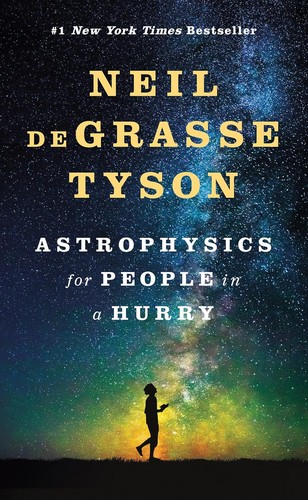
No. The essays are self-contained. Death by Black Hole works as an introduction to Tyson's range and style, or as a supplement for readers who have already read Astrophysics for People in a Hurry.
-
Is it more accessible than most astrophysics books?
Yes. The essay format means no single chapter is too technically dense, and the range of topics keeps it from becoming repetitive. Tyson's primary goal is accessibility and engagement, not comprehensiveness.
-
What is the book's main contribution beyond entertainment?
The science literacy essays, which make a sustained argument about why scientific reasoning — not just scientific facts — should be a core educational goal. These have had some influence on science communication advocacy.