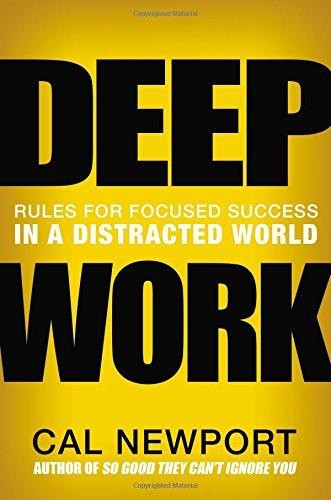
Talk to Deep Work like its author wrote you back.
Get the ideas that fit your life — not generic summaries.
- Chat with the book
- Audiobook-style main ideas
- Adapts to your life and goals
- Helps you take action
What it argues
Deep Work is Cal Newport's case that the ability to focus without distraction on a cognitively demanding task is becoming both rarer and more valuable, and that people who cultivate it will thrive while everyone else stays stuck in shallow busywork. Newport calls focused, undistracted concentration "deep work" and the email-checking, meeting-attending, social-media-skimming alternative "shallow work."
The book makes two arguments back to back. First, deep work is valuable: it's how you learn hard things quickly and produce at an elite level. Newport draws on research showing that elite performers across fields (musicians, programmers, writers) practice in long, undistracted blocks rather than scattered short ones. Second, deep work is rare and getting rarer: open offices, Slack, and the always-on culture of knowledge work make sustained concentration almost impossible by default.
What it gets right
- 1.
Deep work is the ability to focus without distraction on cognitively demanding tasks. It's how you learn hard things quickly and produce at an elite level.
- 2.
Shallow work (email, meetings, Slack) feels productive but rarely creates lasting value. Most knowledge workers spend most of their day on it.
- 3.
Attention is a finite resource. Every context switch costs more than people realize: residue from the previous task lingers and degrades performance on the next.
What it covers
Who wrote it
Cal Newport is a computer science professor at Georgetown University and the author of seven books on focus, productivity, and career strategy, including So Good They Can't Ignore You, Digital Minimalism, and A World Without Email. He writes regularly at calnewport.com and avoids social media on principle. His work draws on academic research and the working habits of high performers across creative and technical fields. He lives in the Washington DC area with his family.
