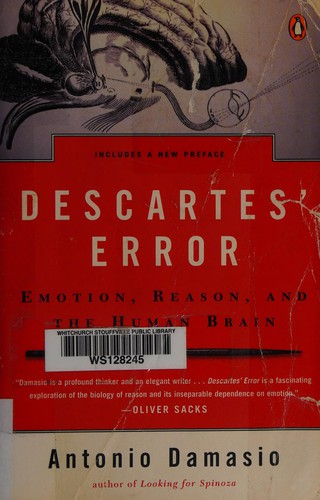
Talk to Descartes' Error: Emotion, Reason, and the Human Brain like its author wrote you back.
Get the ideas that fit your life — not generic summaries.
- Chat with the book
- Audiobook-style main ideas
- Adapts to your life and goals
- Helps you take action
Descartes' Error: Emotion, Reason, and the Human Brain, in detail
Antonio Damasio is a neurologist at USC whose work challenges the centuries-old idea that reason and emotion are separate faculties, with reason the reliable guide and emotion the unreliable interference. Descartes' Error, published in 1994, argues that this picture is wrong — that emotion is not an obstacle to good decision-making but a necessary ingredient of it, and that damage to the neural systems that process emotion reliably produces poor decision-making even when intelligence and logical capacity are intact.
The book's central case is Phineas Gage, the nineteenth-century railroad worker whose personality changed dramatically after a tamping iron destroyed his orbitofrontal cortex in a dynamite accident. Gage survived but was, as his doctors noted, "no longer Gage" — his capacity for decision-making and social behavior was destroyed even though his intelligence and memory remained intact. Damasio uses Gage alongside contemporary patients with similar orbitofrontal damage to argue that this region is critical for connecting emotional knowledge to deliberative reasoning.
The somatic marker hypothesis is Damasio's central theoretical contribution. He proposes that the body generates markers — physical states that tag options as positive or negative — that guide decision-making before and alongside conscious deliberation. When you consider a risky option, your body may generate a subtle aversion signal before you have explicitly weighed the pros and cons. These somatic markers provide a rapid, implicit filtering of options that makes complex decision-making feasible.
Descartes' error, as Damasio defines it, is the separation of mind from body — the idea that thinking can proceed independently of the body's states. He argues that cognition is embodied in ways that cannot be factored out, and that the split between mind and body has distorted philosophy, psychology, and medicine for centuries. The book is technical in places but is written for a general scientific audience and has been enormously influential in both neuroscience and philosophy of mind.
The big ideas
- 1.
Emotion is not an obstacle to reason but a requirement for it. Patients with damage to emotional processing regions make disastrously poor decisions despite intact intelligence and logical capacity.
- 2.
Phineas Gage and patients with orbitofrontal damage demonstrate that the capacity to connect emotional knowledge to deliberative reasoning is a distinct and damageable neural function.
- 3.
The somatic marker hypothesis: bodily states — subtle physical responses tagged to options and outcomes — guide decision-making before and alongside conscious deliberation.
