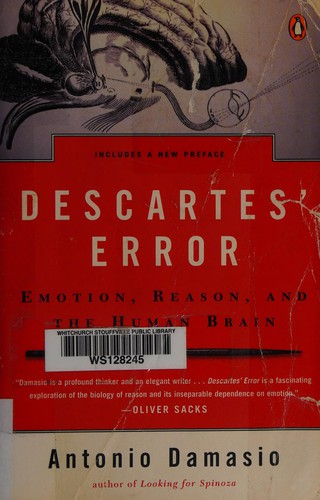
Descartes' Error: Emotion, Reason, and the Human Brain by Antonio Damasio is a 1994 psychology book about emotion and reason, neuroscience, consciousness. Emotion is not an obstacle to reason but a requirement for it. Patients with damage to emotional processing regions make disastrously poor decisions despite intact intelligence and logical capacity.
Summary
Antonio Damasio is a neurologist at USC whose work challenges the centuries-old idea that reason and emotion are separate faculties, with reason the reliable guide and emotion the unreliable interference. Descartes' Error, published in 1994, argues that this picture is wrong — that emotion is not an obstacle to good decision-making but a necessary ingredient of it, and that damage to the neural systems that process emotion reliably produces poor decision-making even when intelligence and logical capacity are intact.
The book's central case is Phineas Gage, the nineteenth-century railroad worker whose personality changed dramatically after a tamping iron destroyed his orbitofrontal cortex in a dynamite accident. Gage survived but was, as his doctors noted, "no longer Gage" — his capacity for decision-making and social behavior was destroyed even though his intelligence and memory remained intact. Damasio uses Gage alongside contemporary patients with similar orbitofrontal damage to argue that this region is critical for connecting emotional knowledge to deliberative reasoning.
The somatic marker hypothesis is Damasio's central theoretical contribution. He proposes that the body generates markers — physical states that tag options as positive or negative — that guide decision-making before and alongside conscious deliberation. When you consider a risky option, your body may generate a subtle aversion signal before you have explicitly weighed the pros and cons. These somatic markers provide a rapid, implicit filtering of options that makes complex decision-making feasible.
Descartes' error, as Damasio defines it, is the separation of mind from body — the idea that thinking can proceed independently of the body's states. He argues that cognition is embodied in ways that cannot be factored out, and that the split between mind and body has distorted philosophy, psychology, and medicine for centuries. The book is technical in places but is written for a general scientific audience and has been enormously influential in both neuroscience and philosophy of mind.
Talk to Descartes' Error: Emotion, Reason, and the Human Brain like its author wrote you back.
Get the ideas that fit your life — not generic summaries.
- Chat with the book
- Audiobook-style main ideas
- Adapts to your life and goals
- Helps you take action
Key takeaways
- 1.
Emotion is not an obstacle to reason but a requirement for it. Patients with damage to emotional processing regions make disastrously poor decisions despite intact intelligence and logical capacity.
- 2.
Phineas Gage and patients with orbitofrontal damage demonstrate that the capacity to connect emotional knowledge to deliberative reasoning is a distinct and damageable neural function.
- 3.
The somatic marker hypothesis: bodily states — subtle physical responses tagged to options and outcomes — guide decision-making before and alongside conscious deliberation.
- 4.
Descartes' error is the dualistic separation of mind from body. Cognition is embodied: the brain's functioning depends on continuous input from and interaction with the body.
- 5.
Without somatic markers, decision-making becomes paralyzed or random. Patients without functional somatic marking can reason explicitly but cannot convert analysis into action.
- 6.
The frontal lobes are critical for integrating emotional signals with deliberative cognition. Their damage does not eliminate intelligence but severs intelligence from practical wisdom.
- 7.
Emotion evolved as a mechanism for aligning behavior with the organism's biological goals. Higher reasoning co-opted this system rather than replacing it.
Discussion questions
Use these on your own, with a book club, or as chat starters in Superbook. Book club version, ready to copy or print →
- 1.
Damasio's core claim is that emotion is necessary for good decision-making. Does that fit your experience — or can you think of cases where emotion clearly led you to a worse decision?
- 2.
The somatic marker hypothesis proposes that body states guide decisions before conscious deliberation begins. Can you identify examples in your own experience of noticing a physical response to an option before you had explicitly analyzed it?
- 3.
Phineas Gage was 'no longer Gage' after his accident but retained his intelligence. What does that suggest about the relationship between cognitive ability and personhood?
- 4.
Damasio argues that the Cartesian separation of mind from body has distorted how medicine treats illness. What aspects of medicine would be different if the body-mind connection were taken seriously from the start?
- 5.
The book was published in 1994. How has the somatic marker hypothesis been received and developed in the subsequent thirty years of neuroscience?
- 6.
He argues that pure reason — reasoning disconnected from emotional knowledge — produces poor real-world decisions. What are the implications for how we design and evaluate AI systems that reason without bodies?
- 7.
The frontal lobe cases show that practical wisdom is not the same as intelligence. Can you think of people you know who are highly intelligent but lack practical wisdom, and what might explain the gap?
- 8.
Damasio's work implies that decisions made by patients with orbitofrontal damage are not simply bad choices but are physiologically impaired. What are the implications for legal and moral responsibility?
- 9.
He distinguishes between primary emotions (instinctive responses to stimuli) and secondary emotions (acquired responses to representations). How does that distinction map onto how you experience your own emotional responses?
- 10.
The embodiment argument means you cannot separate clear thinking from bodily state. What practical implications does this have for when and how you make important decisions?
- 11.
Which aspect of Damasio's argument do you find most convincing, and which seems most speculative?
Themes
Frequently asked questions
-
What is Descartes' error?
Damasio's term for the Cartesian separation of mind from body — the idea that thinking is an activity of a disembodied mind rather than of an embodied brain. He argues this error has distorted philosophy, medicine, and our understanding of decision-making.
-
What is the somatic marker hypothesis?
The proposal that bodily states — physical responses tagged to past experiences with options — serve as rapid filters in decision-making. When you consider a risky option, your body may generate an aversion signal before you have consciously analyzed the risk.
-
Is this a difficult book?
Moderately. Damasio writes for a general scientific audience and explains neurological concepts clearly, but the book is denser than popular neuroscience aimed at general readers. Readers comfortable with Thinking, Fast and Slow will find it manageable.
-
How has the somatic marker hypothesis been received scientifically?
It has generated substantial research and has largely been supported in its broad outlines, though specific mechanisms remain debated. The basic finding that orbitofrontal damage impairs decision-making without impairing intelligence is well-replicated.
-
Who should read Descartes' Error?
Anyone interested in the neuroscience of decision-making, the philosophy of mind, or the relationship between emotion and reason. Also valuable for anyone who has noticed that purely analytical approaches to important decisions miss something that emotional intuition provides.
Similar books

Seven and a Half Lessons About the Brain
Lisa Feldman Barrett
How Emotions Are Made: The Secret Life of the Brain
Lisa Feldman Barrett
Phantoms in the Brain: Probing the Mysteries of the Human Mind
V. S. Ramachandran and Sandra Blakeslee
Incognito: The Secret Lives of the Brain
David Eagleman
