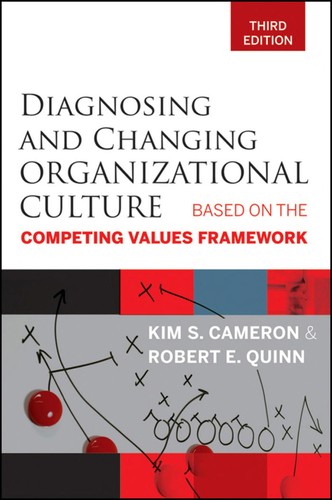
Talk to Diagnosing and Changing Organizational Culture like its author wrote you back.
Get the ideas that fit your life — not generic summaries.
- Chat with the book
- Audiobook-style main ideas
- Adapts to your life and goals
- Helps you take action
Diagnosing and Changing Organizational Culture, in detail
Diagnosing and Changing Organizational Culture introduces the Competing Values Framework, a model Cameron and Quinn developed at the University of Michigan for assessing and intentionally changing organizational culture. The framework organizes culture types along two axes — flexibility versus stability, and internal focus versus external focus — producing four quadrants: Clan (collaborative, people-first), Adhocracy (innovative, entrepreneurial), Market (results-driven, competitive), and Hierarchy (structured, process-oriented).
The book's practical center is the Organizational Culture Assessment Instrument (OCAI), a validated survey that asks employees to describe their organization's current culture and their preferred culture across six dimensions. The gap between current and preferred profiles is the starting point for a change initiative. Cameron and Quinn argue that this gap analysis is more honest than a company's stated values, because employees describe behavior they actually observe rather than aspirations leadership has posted on a wall.
Culture change, the authors argue, is led by changing leadership behavior first. Leaders who want to move their organization toward a more Clan profile but continue to reward only outcomes are sending incompatible signals. The book gives detailed advice on what behavioral changes look like for each quadrant shift, and it includes case examples from manufacturing, healthcare, and services organizations. A useful chapter addresses how to build culture change into existing management processes rather than layering it on as a separate initiative.
This is a textbook more than a business narrative. The writing is denser than popular management books, and the OCAI is designed for professional facilitators. But for leaders and consultants serious about culture work — rather than motivated by the desire to put culture on a slide deck — it remains one of the few books that treats the subject with genuine rigor. The CVF has been applied in thousands of organizations and continues to be one of the most researched culture assessment tools available.
The big ideas
- 1.
The Competing Values Framework maps culture along two axes — flexibility/stability and internal/external focus — producing four types: Clan, Adhocracy, Market, and Hierarchy.
- 2.
Every organization has a culture profile across all four types, not a single dominant type. The question is the balance and whether it fits the strategy.
- 3.
The OCAI measures the gap between current culture and preferred culture, which reveals where change energy should be focused.
